

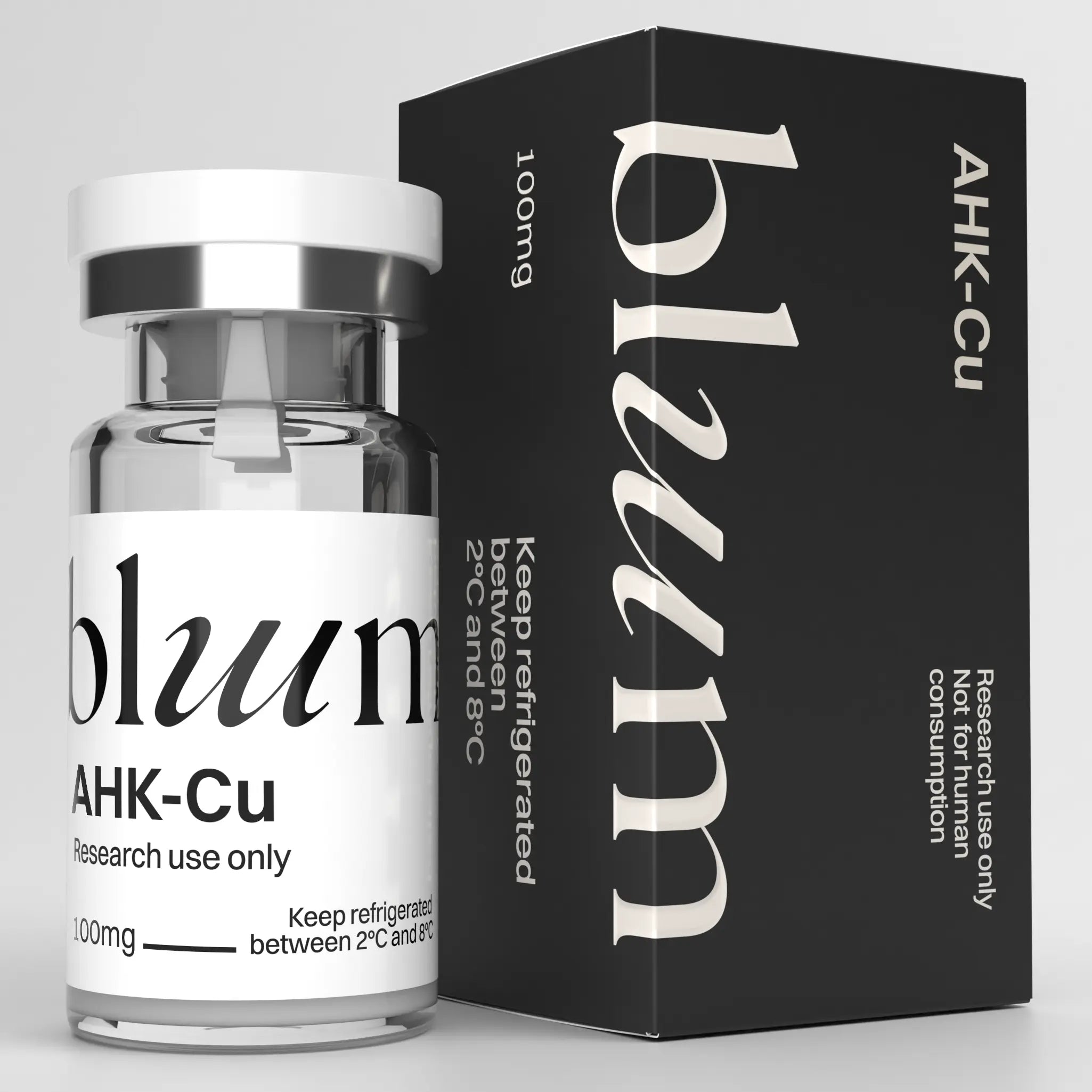
AHK-Cu
 Money Back
Guarantee
Money Back
Guarantee Satisfaction
Guarantee
Satisfaction
Guarantee Easy Returns
 Secure
Ordering
Secure
Ordering 2-Day
Shipping
2-Day
Shipping Third Party
Tested
Third Party
Tested Batch & Lot
Tracking
Batch & Lot
TrackingLab results
RESEARCH USE ONLY
These compounds are NOT intended for human consumption, clinical use, or veterinary applications. We are not affiliated with any pharmaceutical companies or their commercial medications. By placing an order, you certify these materials will be used exclusively for in vitro testing and laboratory experimentation only. Bodily introduction of any kind into humans or animals is strictly forbidden by law. This product should only be handled by licensed, qualified professionals. This product is not a drug, food, or cosmetic and may not be misbranded, misused or mislabeled as a drug, food or cosmetic.
About AHK-Cu
AHK-Cu is a copper-binding tripeptide complex used in biochemical and cellular research to study copper-dependent signaling, gene expression modulation, and tissue remodeling pathways. It is a model compound for investigating how small copper peptides influence cellular repair signaling, extracellular matrix dynamics, and follicular biology in research models. Bluum Peptides supplies stable, high-purity AHK-Cu tested and verified by accredited labs to support reproducible research.Sold for research use only.
AHK-Cu Product Specifications
| Product Specifications | AHK-Cu lyophilized powder in a sealed glass vial (100mg vial). |
|---|---|
| Application | Research peptide–metal complex studied in cellular signaling, extracellular matrix biology, and copper-dependent pathway research. |
| Appearance | Blue lyophilized powder in a glass vial. |
| Chemical Formula | C15H26ClCuN6O4 |
| PubChem CID | 7408502 |
| CAS Number | 126828-32-8 |
| Molecular Weight | 354.41 g/mol |
| Synonyms | 126828-32-8, Ala-His-Lys, L-alanyl-L-histidyl-L-lysine, alanylhistidyllysine, 1AVY5QO8WR |
| Storage | Short-term: 36–46 °F (2–8 °C); Long-term: –4 °F (–20 °C) sealed, protected from light/moisture. |
Chemical Structure
What Is AHK-Cu?
AHK-Cu is a copper-binding tripeptide complex composed of alanine, histidine, and lysine coordinated with a copper(II) ion. It is classified as a copper peptide and studied in experimental models involving peptide-mediated signaling, cellular communication, and metal-peptide interactions. As part of a broader family of naturally occurring and synthetic copper-peptide complexes, AHK-Cu has attracted research interest because of the important role copper ions play in numerous biological processes and enzyme systems.
Copper-peptide complexes are commonly investigated for their ability to participate in cellular signaling networks and interact with pathways associated with tissue homeostasis, extracellular matrix biology, and cellular regulatory processes. Within this area of research, AHK-Cu is frequently studied as a small, structurally defined peptide-metal complex that can be used to examine how copper-associated signaling influences biological systems under controlled laboratory conditions.
In the scientific literature, AHK-Cu has been investigated in cell-culture systems and other preclinical research models involving gene-expression pathways, extracellular matrix regulation, cellular signaling networks, and tissue-associated biological processes. Researchers have also explored its use in experimental models related to follicle-associated biology, cell signaling, and broader peptide-mediated regulatory mechanisms. However, these investigations remain largely preclinical, and the precise molecular pathways involved continue to be studied.
Unlike receptor-selective peptides that act through a single defined molecular target, AHK-Cu is generally investigated for its potential interactions across multiple interconnected signaling pathways. This systems-oriented profile has made it a useful research tool for studying peptide-metal complexes and copper-associated regulatory biology.
Most available findings originate from laboratory and preclinical research. As such, observations involving AHK-Cu should be interpreted strictly within an experimental framework and should not be extrapolated to human or veterinary applications.
Bluum Peptides supplies AHK-Cu as a high-purity, lyophilized research compound manufactured using controlled synthesis and purification processes to support consistency across experimental studies. Each batch undergoes analytical verification to confirm identity and purity, with lot-specific Certificates of Analysis (COAs) available for review.
AHK-Cu is supplied strictly for research use only and is not intended for human consumption, therapeutic use, diagnostic use, or veterinary applications.
AHK-Cu Mechanism of Action (Research Only)
AHK-Cu is a copper-binding tripeptide complex studied for its potential role in copper-associated signaling, peptide-mediated cellular communication, and regulatory biological processes. Unlike receptor-selective peptides that act through a single molecular target, AHK-Cu is generally investigated as a peptide-metal complex whose activity may be influenced by interactions with multiple copper-responsive pathways and regulatory networks.
Current mechanistic understanding is derived primarily from in vitro experiments, cell-culture systems, and other preclinical research models. While several biological pathways have been examined in association with AHK-Cu, the precise molecular mechanisms underlying its activity remain an active area of investigation.
Structural and Chemical Basis
AHK-Cu consists of the tripeptide sequence alanine-histidine-lysine complexed with a copper(II) ion [1]. The histidine residue plays an important role in copper coordination, contributing to the formation of a stable peptide-metal complex suitable for experimental study.
As a copper peptide, AHK-Cu is frequently used in research examining how peptide-bound copper differs from unbound copper within biological systems. This distinction is important because metal-binding peptides can influence the availability, distribution, and signaling behavior of biologically relevant trace elements under controlled laboratory conditions.
Copper-Associated Signaling Research
One of the primary areas of AHK-Cu research involves signaling pathways associated with copper-dependent biological processes [1]. Researchers use experimental models to investigate how peptide-bound copper may interact with cellular signaling networks and influence regulatory pathways that rely on trace-metal availability.
Because copper participates in numerous biological systems, AHK-Cu is often studied as a model compound for exploring how peptide-mediated metal transport and signaling may contribute to broader cellular communication processes.
Cellular Regulation and Gene Expression Studies
AHK-Cu has also been investigated in experimental models examining cellular regulation, transcriptional activity, and peptide-mediated signaling pathways [2]. These studies explore how copper-peptide complexes may influence signaling networks associated with cellular communication and regulatory biology.
Rather than acting as a direct receptor agonist, AHK-Cu is generally studied as a signaling-associated peptide complex whose effects may arise through interactions with interconnected biological pathways.
Extracellular Matrix and Tissue-Associated Research
Additional investigations have examined AHK-Cu in cell-culture models involving extracellular matrix biology, tissue-associated signaling, and cellular communication networks [3]. Researchers use these systems to study how copper-associated signaling pathways may interact with biological processes involved in cellular organization and matrix regulation.
Because these pathways involve numerous interacting factors, AHK-Cu is typically evaluated within broader systems-level research frameworks rather than as a single-target signaling molecule.
Follicle-Associated and Dermal Cell Models
AHK-Cu is frequently studied in experimental models involving follicle-associated cells, dermal cell populations, and tissue-related signaling environments. These investigations examine how peptide-metal complexes may interact with cellular communication networks and copper-responsive pathways within controlled laboratory settings.
Such models contribute to a broader understanding of copper-peptide biology and the potential role of trace-metal signaling in complex cellular systems.
Ongoing Mechanistic Investigation
Despite extensive research interest, the precise mechanisms underlying AHK-Cu activity remain incompletely characterized. Contemporary research continues to explore its potential involvement in copper-associated signaling, peptide-mediated communication, and cellular regulatory processes using modern molecular biology and cell-culture models.
AHK-Cu is supplied strictly for laboratory research use and serves as a research tool for investigating copper-peptide biology, cellular signaling pathways, and regulatory peptide-metal interactions. It is not intended for human consumption, therapeutic use, diagnostic use, or veterinary applications.
AHK-Cu Research Applications (Observations from Studies)
AHK-Cu has been investigated in preclinical and translational research as a tool for studying copper-peptide biology, copper-associated signaling pathways, and peptide-mediated cellular communication. Most available findings originate from cell-culture systems, mechanistic laboratory studies, and other non-clinical research models designed to examine how peptide-bound copper interacts with biological signaling networks.
The observations described below reflect experimental research findings and should be interpreted strictly within controlled laboratory environments. They do not represent established clinical outcomes or approved applications.
Copper-Associated Signaling Research
One of the primary areas of AHK-Cu research involves signaling pathways associated with copper-dependent biological processes. Researchers use experimental models to investigate how peptide-bound copper may influence cellular communication networks and interact with pathways that depend on trace-metal availability [1].
These studies are particularly valuable for examining how copper presented within a peptide complex differs from unbound copper in laboratory systems and how these differences may influence signaling behavior under controlled conditions.
Cellular Regulation and Gene Expression Studies
AHK-Cu has also been investigated in experimental models examining cellular regulation, transcriptional activity, and peptide-mediated signaling pathways. Researchers use these systems to explore how copper-peptide complexes may interact with regulatory networks involved in cellular communication and biological organization.
This work contributes to a broader understanding of how trace-metal signaling and peptide-mediated processes intersect within complex biological systems.
Extracellular Matrix and Tissue-Associated Models
Additional research has examined AHK-Cu in cell-culture models involving extracellular matrix biology, tissue-associated signaling, and cellular communication networks [2]. These studies investigate interactions among copper-responsive pathways, matrix-related signaling processes, and broader regulatory systems.
Because extracellular matrix regulation involves numerous interconnected biological factors, AHK-Cu is generally studied within systems-level research frameworks rather than as a single-target experimental compound.
Follicle-Associated Research Models
AHK-Cu is frequently evaluated in experimental models involving follicle-associated cells and tissue-related signaling environments. Researchers use these systems to investigate how peptide-bound copper may interact with local cellular communication networks and copper-responsive biological pathways
These studies focus on pathway characterization, signaling relationships, and the role of peptide-metal complexes within complex cellular environments rather than specific biological outcomes.
Comparative Copper-Peptide Research
AHK-Cu is often examined alongside other copper-peptide complexes in studies investigating metal-peptide interactions, signaling characteristics, and copper-associated regulatory processes. Comparative models help researchers evaluate how differences in peptide structure may influence copper coordination, signaling behavior, and biological interactions under laboratory conditions.
This ongoing body of research continues to support the use of AHK-Cu as a tool for investigating copper-peptide biology, cellular communication pathways, and peptide-mediated regulatory mechanisms in experimental settings.
Bluum Peptides does not make medical or therapeutic claims regarding AHK-Cu. All findings referenced here are derived from experimental and non-clinical research settings. This compound is supplied strictly for laboratory research use and is not intended for clinical, diagnostic, therapeutic, veterinary, or human applications.
AHK-Cu vs GHK-Cu vs BPC-157 Comparison
|
Parameter |
AHK-Cu |
||
|
Compound Class |
Copper–tripeptide complex (alanine–histidine–lysine) |
Copper–tripeptide complex (glycine–histidine–lysine) |
Synthetic gastric-derived peptide fragment |
|
Structural Type |
Synthetic peptide–copper chelate |
Naturally occurring peptide–copper chelate |
Linear peptide (no metal chelation role) |
|
Core Mechanism Focus |
Peptide-bound copper delivery and copper-sensitive pathway modulation |
Broad gene-expression and matrix-signaling modulation linked to copper biology |
Angiogenic and cytoprotective signalling pathway studies in non-clinical models. |
|
Mechanism Complexity |
Multi-pathway, copper-dependent signaling context |
Multi-pathway transcriptional and matrix regulation context |
Multi-pathway vascular and cytoprotective signalling context |
|
Pathway Targeting Style |
Microenvironment copper signaling modulation |
Systems-level gene and matrix regulation |
Growth factor, nitric oxide, and vascular-response pathways |
|
Research Modeling Value |
Targeted copper-peptide signaling exploration |
Reference copper-peptide signaling model |
Broad multi-pathway signalling modelling. |
|
Intended Use Classification |
Research-use compound |
Research-use compound (also studied in cosmetic science contexts) |
Research-use compound (investigational) |
|
Regulatory Status |
Not approved for clinical or veterinary use |
Not approved for clinical or veterinary use |
Not an approved drug; investigational research compound |
Note: AHK-Cu has a narrower and more preliminary literature base than GHK-Cu and regenerative peptides like BPC-157. Its experimental value centers on peptide-mediated copper signaling rather than broad regenerative pathway activation.
AHK-Cu Laboratory Safety & Handling
AHK-Cu is supplied as a lyophilized copper-peptide complex and should be handled in accordance with established laboratory procedures for peptide-based research materials. Appropriate handling, storage, and documentation practices help maintain material integrity and support consistency across experimental workflows.
As a peptide-metal complex, AHK-Cu may be sensitive to environmental factors such as moisture, temperature fluctuations, excessive light exposure, and improper handling. Laboratory protocols should therefore be designed to minimize avoidable sources of degradation, contamination, and experimental variability.
Laboratory Handling Considerations
Best-practice laboratory guidance includes:
-
Follow institutional standard operating procedures (SOPs), chemical hygiene plans, and approved research protocols.
-
Wear appropriate personal protective equipment (PPE), including gloves, laboratory coat, and eye protection.
-
Conduct weighing, preparation, and handling procedures in controlled laboratory environments where appropriate to minimize contamination and environmental exposure.
-
Handle lyophilized material carefully to avoid unnecessary particulate dispersion during transfer or preparation.
-
Use suitable laboratory equipment, containers, and documentation practices to support consistency and traceability.
-
Record lot numbers, preparation details, storage conditions, and associated laboratory documentation to support reproducibility.
-
Follow institutional procedures for spill response, waste management, and incident reporting.
These practices are particularly important in copper-peptide and cellular signaling research, where material consistency can contribute to reliable experimental outcomes.
Storage and Stability Considerations
Appropriate storage conditions help preserve the integrity of lyophilized peptide materials during laboratory use.
-
Store lyophilized material at approximately -4°F (-20°C), protected from light and moisture.
-
For short-term handling, unopened material may be stored under refrigerated conditions (36–46°F / 2–8°C) when appropriate.
-
Minimize repeated freeze-thaw cycles to reduce degradation.
-
Maintain consistent storage conditions across experiments to support reproducibility.
-
Clearly label prepared materials with relevant concentration, preparation, and storage information.
-
Inspect materials and associated documentation prior to use as part of routine laboratory quality-control procedures.
Careful storage and handling practices can help reduce avoidable sources of experimental variability and support consistency across research workflows.
Bluum Peptides supplies AHK-Cu strictly for research use only. This material is not intended for human consumption, therapeutic use, diagnostic use, or veterinary applications and should be handled exclusively within qualified laboratory settings.
Certificate of Analysis (COA) & Quality Assurance
Each AHK-Cu lot is accompanied by a third-party–verified Certificate of Analysis (COA) to support research reproducibility, batch traceability, and data integrity. Because AHK-Cu is a copper–peptide complex used in controlled laboratory settings, lot-level analytical verification is important for confirming both peptide identity and overall material quality prior to experimental use.
COAs for AHK-Cu and similar peptide research compounds typically include:
-
Identity verification using validated analytical techniques (such as mass spectrometry or equivalent peptide identification methods)
-
Purity and composition analysis (commonly via HPLC or comparable chromatography methods)
-
Confirmation of peptide profile and major peak percentage
-
Relevant physicochemical data appropriate to the compound type (such as solubility characteristics or stability-related notes where applicable)
-
Lot or batch number tied to the specific production run
-
Testing date and analytical method references
-
Laboratory authorization or validation markers
Bluum Peptides works with independent third-party analytical laboratories to ensure objective verification and consistent quality standards across production lots. Independent testing helps maintain separation between production and analysis and supports transparent reporting practices.
Scientific References
1. Iakovidis I, Delimaris I, Piperakis SM. Copper and its complexes in medicine: a biochemical approach. Mol Biol Int. 2011;2011:594529.
https://pmc.ncbi.nlm.nih.gov/articles/PMC3195324/
2. Kardos J, Héja L, Simon Á, Jablonkai I, Kovács R, Jemnitz K. Copper signalling: causes and consequences. Cell Commun Signal. 2018 Oct 22;16(1):71. doi: 10.1186/s12964-018-0277-3. Erratum in: Cell Commun Signal. 2018 Nov 12;16(1):80.
https://pmc.ncbi.nlm.nih.gov/articles/PMC6198518/
3. Yergeshov AA, Zoughaib M, Ishkaeva RA, Savina IN, Abdullin TI. Regenerative Activities of ROS-Modulating Trace Metals in Subcutaneously Implanted Biodegradable Cryogel. Gels. 2022 Feb 14;8(2):118.
https://pmc.ncbi.nlm.nih.gov/articles/PMC8872170/
4. Tripathi AK, Saxena P, Thakur P, Rauniyar S, Samanta D, Gopalakrishnan V, Singh RN, Sani RK. Transcriptomics and Functional Analysis of Copper Stress Response in the Sulfate-Reducing Bacterium Desulfovibrio alaskensis G20. Int J Mol Sci. 2022 Jan 26;23(3):1396.
https://pmc.ncbi.nlm.nih.gov/articles/PMC8836040/
You ask,
we answer.
Are these peptides quality tested?
Absolutely. Our analytical testing is conducted by Janoshik Analytical, BioRegen, or Freedom Diagnostics, independent third-party laboratories that verify the identity, purity, and composition of our research products. All products are guaranteed to test at 98% purity or higher. Each CoA includes purity analysis, peptide sequence confirmation, date of analysis, and an endotoxin report.
What are typical delivery times?
Free 2-Day Air shipping is available when qualifying merchandise totals reach $200. Overnight Air is also available. Please allow up to 24 hours for processing.
Every package comes with professional packaging and tracking updates via email.
How should these compounds be stored?
Our peptides are shipped in lyophilized form, which is stable at room temperature during transit. Once received, store unopened vials in a cool, dry place.
Are products stable during shipping?
Our peptides are shipped in lyophilized (freeze-dried) form, which ensures stability during transit. This powder form is highly stable at room temperature and resistant to temperature fluctuations that occur during shipping.
Research has shown no significant degradation or loss of purity when lyophilized peptides are exposed to room temperature during typical shipping timeframes. Each batch is verified for purity upon production, and our stability testing confirms maintenance of product integrity during standard shipping conditions.
What are your bulk ordering options?
For bulk inquiries and volume pricing, please contact us.
What is the shelf life/expiration of unopened vials?
Each lot lists a best-by/expiration on the vial label and COA. As general guidance, lyophilized peptides stored as directed are typically stable 12–24 months (often longer at –20 °C). Short shipping periods at ambient temperature are normal. Actual stability depends on sequence and storage conditions.