

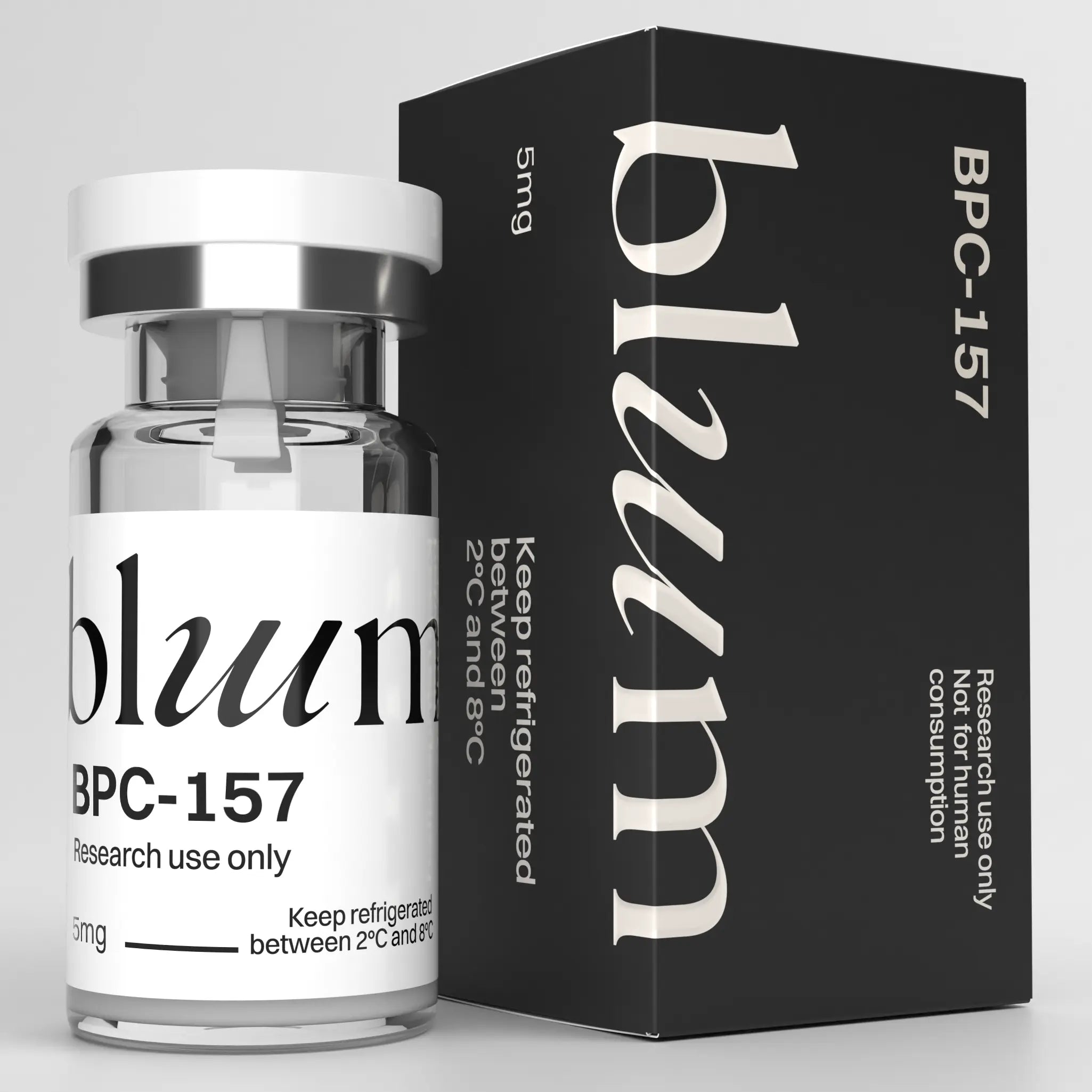







What is BPC 157?
BPC157, also known as Body Protection Compound-157, is a synthetic pentadecapeptide originally derived from a partial sequence identified in human gastric juice[1]. It is a cytoprotective research peptide and has been investigated for its broad interactions with cellular signaling systems involved in tissue integrity and stress response.
Early interest in BPC 157 emerged from gastrointestinal research exploring naturally occurring peptides with stability in acidic environments. In scientific literature, BPC-157 is studied using in vitro systems and animal models to explore its relationship with nitric oxide signaling, growth factor–related pathways, angiogenic signaling, and cellular responses to mechanical or oxidative stress.
These studies aim to better understand how certain peptides may influence coordinated signaling processes rather than single, receptor-specific mechanisms.
However, controlled human clinical evidence remains limited, and existing findings should be interpreted within a preclinical research framework only.
BPC157 Mechanism of Action (Research Only)
In experimental models, BPC-157 exhibits multi-pathway (pleiotropic) activity, studied in connection with cellular signalling, vascular responses, and tissue-level processes. BPC-157 does not appear to function as a classic receptor agonist. Research instead examines its interaction with several interconnected biological pathways involved in cellular communication, stress response, and structural maintenance.
Structural and Chemical Basis
BPC-157 is a 15-amino-acid peptide, classifying it as a short, stable synthetic peptide fragment. It demonstrates unusual stability in gastric fluid and other challenging experimental environments, which has made it a useful subject for oral and systemic research models. Its structural resilience allows researchers to observe sustained pathway interaction over time, and its small size is studied in connection with tissue penetration and interaction with intracellular and paracrine signalling systems.
Nitric Oxide Signaling Modulation
One of the most consistently observed mechanisms in research models is BPC-157’s interaction with nitric oxide (NO) signaling pathways. Experimental data are studied in connection with the balance between nitric oxide synthase activity and vascular tone in stressed tissues. This makes BPC-157 a subject for studying vascular signalling and endothelial behaviour under controlled laboratory conditions.
Angiogenesis and Vascular Response Pathways
Animal and in-vitro studies examine BPC-157 in connection with angiogenic signalling, the process by which new blood vessels form from existing ones. This involves growth-factor-related pathways and endothelial cell behaviour rather than direct stimulation of vessel growth. It provides a model for examining how microcirculation and tissue perfusion adapt under stress conditions, within non-clinical models only.
Integrated Mechanistic Profile
Taken together, research models suggest BPC-157 operates through overlapping mechanisms rather than a single dominant pathway. Observed interactions include:
-
Modulation of nitric oxide and vascular signaling
-
Influence on angiogenic and endothelial responses
-
Regulation of cellular stress and inflammatory balance
These interconnected effects position BPC-157 as a versatile research tool for examining tissue integrity, signaling coordination, and adaptive biological responses.
Note: BPC-157 is supplied strictly for research use only. It is intended as an experimental compound for studying biological mechanisms and is not approved for clinical, therapeutic, diagnostic, or human use.
Research Applications (Observations from Studies)
BPC-157 has been examined across preclinical research settings, including in vitro experiments and animal models. All observations described below reflect controlled research conditions and should not be interpreted as clinical outcomes or as applicable to human or veterinary use. BPC-157 is of research interest because it has been studied in relation to multiple signaling systems, making it a subject for investigating complex biological interactions rather than isolated molecular targets.
Tissue Organization and Structural Response Models
A common area of research involves experimental models evaluating tissue organization and structural-response processes. In animal studies, researchers examine markers associated with connective tissues, including tendon, ligament, muscle, and related structures, within controlled experimental systems. These investigations are used to study signaling pathways associated with extracellular matrix organization, cellular communication, and localized physiological responses in laboratory models.
Vascular and Microcirculatory Research
BPC-157 has been studied in connection with vascular signaling and microcirculatory research in non-clinical models. Experimental investigations examine markers associated with endothelial signaling, vascular responsiveness, and localized circulation-related processes under controlled laboratory conditions. These studies are used to explore relationships between signaling pathways involved in vascular function and broader physiological response systems.
Gastrointestinal and Mucosal Research Models
Due to its origin as a gastric protein fragment, BPC-157 has been examined in gastrointestinal and mucosal research models. Experimental studies evaluate tissue-associated markers and signaling pathways within gastric and intestinal systems following controlled laboratory challenges. These investigations are used to study how signaling networks and tissue-associated processes are organized and evaluated within experimental environments.
Inflammatory Signaling and Cellular Stress Research
BPC-157 has also been investigated in studies involving inflammatory signaling pathways and cellular stress responses. Research models evaluate signaling markers associated with cytokine activity, oxidative-stress pathways, and cellular response mechanisms under controlled experimental conditions. These investigations focus on pathway relationships, signaling dynamics, and system-level interactions rather than specific biological outcomes.
Integrated Multi-Pathway Research Interest
Across published studies, BPC-157 has been examined in relation to multiple signaling systems, including vascular, cellular, and tissue-associated pathways. This has made it a subject of interest in exploratory research investigating how signaling networks interact across different biological domains.
Its broad research profile distinguishes it from more narrowly targeted experimental compounds and contributes to its continued use in hypothesis-generating and pathway-characterization studies.
Laboratory Handling and Storage Considerations
BPC-157 should be handled in accordance with institutional laboratory procedures and established practices applicable to lyophilized research peptides. Appropriate measures should be taken to minimize contamination, moisture exposure, and environmental conditions that may affect compound integrity during storage and handling.
For storage, maintain conditions consistent with product documentation and laboratory protocols. Protect material from excessive heat, light, moisture, and unnecessary environmental stress during storage and handling.
Bluum Peptides does not make medical or therapeutic claims regarding BPC-157. This compound is supplied strictly for laboratory research use only and is not intended for clinical, diagnostic, therapeutic, veterinary, or human applications.
BPC-157 vs TB-500 vs BPC157 + TB500 Blend
|
Feature |
BPC-157 |
||
|
Molecular / Structural Classification |
Synthetic 15–amino acid peptide derived from a gastric protein fragment |
Synthetic peptide fragment based on thymosin beta-4 |
Multi-component peptide blend |
|
Composition Scope |
Single defined peptide |
Single defined peptide |
Combination of research peptides |
|
Primary Biological Pathways Studied |
Nitric oxide signaling, angiogenesis-related pathways, inflammatory and stress-response modulation |
Actin dynamics, cell migration, angiogenic signaling |
Cytoskeletal signalling, inflammatory modulation, multi-pathway interaction |
|
Mechanism Complexity |
Multi-pathway (pleiotropic) signaling modulation |
Multi-pathway, with emphasis on cytoskeletal organization |
Multi-peptide, multi-pathway (combinatorial signaling model) |
|
Receptor Dependence |
No single dominant receptor identified in research models |
No specific receptor; indirect intracellular signaling effects |
No single receptor; effects modeled through overlapping intracellular pathways |
|
Primary Research Focus Areas |
Tissue stress and injury models, vascular response, gastrointestinal and connective tissue studies |
Muscle, tendon, and soft tissue research models |
Coordinated tissue response and multi-pathway interaction studies |
|
Research Stage / Regulatory Status |
Research-use compound; not approved for human or veterinary use |
Research-use compound; not approved for human or veterinary use |
Research-use-only blend; not approved for human or veterinary use |
|
Intended Use Classification |
Laboratory research use only |
Laboratory research use only |
Laboratory research use only |
BPC-157 Laboratory Safety & Handling in Research Use
To support experimental integrity and repeatability, handle BPC-157 using established laboratory best practices:
-
Perform all handling using sterile technique and validated standard operating procedures (SOPs appropriate to the experimental model).
-
Record lot numbers, storage conditions, preparation methods in laboratory documentation.
-
Retain certificates of analysis (COAs) and incoming quality control documentation alongside study records.
-
Store, handle, and dispose of materials in accordance with institutional safety programs and the storage specifications provided.
-
Maintaining thorough documentation and consistent handling protocols is essential for reproducibility across experiments and research sites.
Laboratory Safety Considerations
BPC-157 should be handled in the same manner as other research compounds without a fully characterized toxicological profile.
-
Personal protective equipment (PPE): Use appropriate PPE, including a lab coat, nitrile gloves, and eye protection. Respiratory protection may be required when handling powders, depending on institutional SOPs.
-
Engineering controls: Minimize the generation of aerosols or dust. Conduct weighing, transfer, or preparation procedures within a fume hood or biosafety cabinet as required by facility guidelines.
-
Exposure prevention: Avoid inhalation, ingestion, or contact with skin and eyes. Do not taste or smell the material. Wash hands thoroughly after handling.
-
Storage: Keep containers tightly sealed and protected from light and moisture. Store under conditions specified in the Storage section.
-
Spill response: Address spills using appropriate PPE and institutional spill-response procedures. Avoid dry sweeping or actions that may aerosolize material.
-
Disposal: Dispose of all unused material, consumables, and waste in accordance with local regulations and institutional hazardous waste protocols.
-
Documentation: Safety data sheets or additional handling guidance may be available upon request. Maintain all lot and handling records to support traceability.
Certificate of Analysis (COA) & Quality Assurance
Each batch of BPC-157 supplied by Bluum Peptides is accompanied by a third-party–verified Certificate of Analysis (COA) to support research reproducibility and data integrity.
This documentation is intended to help researchers confirm compound identity and consistency prior to experimental use. COAs typically include identity verification using analytical techniques such as mass spectrometry or equivalent methods, along with purity assessment through chromatography-based analysis (e.g., HPLC).
Relevant physicochemical data, including concentration or stability-related information where applicable, may also be provided. Each COA documents the lot number, testing date, and analytical methodologies used during evaluation.
Bluum Peptides works with independent analytical laboratories to ensure objective verification and consistent quality standards across production batches. Certificates of Analysis are available for review, and you are encouraged to ask for them to help meet internal records, audits, and reproducibility requirements.
Scientific References
1. Sikiric, P., Seiwerth, S., Skrtic, A., Staresinic, M., Strbe, S., Vuksic, A., Sikiric, S., Bekic, D., Soldo, D., Grizelj, B., Novosel, L., Beketic Oreskovic, L., Oreskovic, I., Stupnisek, M., Boban Blagaic, A., & Dobric, I. (2025). Stable gastric pentadecapeptide BPC 157-NO-system relation. Curr Pharm Des. 2014;20(7):1126-35.
https://www.mdpi.com/1424-8247/18/6/928
2. Seiwerth S, Brcic L, Vuletic LB, Kolenc D, Aralica G, Misic M, Zenko A, Drmic D, Rucman R, Sikiric P. BPC 157 and blood vessels. Curr Pharm Des. 2014;20(7):1121-5.
https://pubmed.ncbi.nlm.nih.gov/23782145/