

Melanotan II (MT-2, Melanotan 2; CAS 121062-08-6) is a cyclic synthetic heptapeptide analogue of alpha-melanocyte-stimulating hormone (molecular formula C50H69N15O9, molecular weight 1,024.18 g/mol) supplied lyophilized for melanocortin receptor research. Bluum Peptides stocks 10 mg vials ($39), with current lot DPS-2405353 tested at 99.29% HPLC purity (9.9 mg measured) by Horizon Analytical in the lab report library.
Unlike linear alpha-MSH fragments, Melanotan II contains a lactam ring bridge and a C-terminal amide that alter both proteolytic stability and receptor selectivity across melanocortin subtypes MC1R, MC3R, MC4R, and MC5R. Laboratories use it as a multi-receptor tool compound in cell-signaling and neuroendocrine models.
At the bench, sourcing and quality control focus on four checks: confirming the 1,024.18 g/mol mass to distinguish Melanotan II from PT-141, verifying cyclization by LC-MS, reviewing RP-HPLC purity alongside net peptide content, and confirming lot-matched LAL endotoxin testing.
What is Melanotan II (MT-2) peptide?
Melanotan II (also written Melanotan-II, Melanotan-2, and MT-2; PubChem CID 92432) is a seven-amino-acid synthetic cyclic peptide with the sequence Ac-Nle-cyclo[Asp-His-D-Phe-Arg-Trp-Lys]-NH2. Researchers at the University of Arizona originally synthesized the compound in the 1980s while mapping structure-activity relationships of endogenous alpha-MSH.
Three deliberate structural modifications distinguish Melanotan II from native 13-residue alpha-MSH. Replacing methionine with norleucine (Nle) reduces oxidative liability, substituting D-phenylalanine stabilizes the beta-turn pharmacophore, and forming a lactam bridge between aspartic acid and lysine locks the peptide into a compact cyclic conformation.
Because the literature splits across four naming conventions (Melanotan II, Melanotan 2, Melanotan-II, and MT-2), searching all variants together ensures complete coverage of analytical methods and melanocortin receptor assays.
What research contexts investigate Melanotan II?
Preclinical and in-vitro studies use Melanotan II to probe G-protein-coupled melanocortin receptor signaling across MC1R, MC3R, MC4R, and MC5R. Because it binds multiple melanocortin subtypes, laboratories treat it as a broad-spectrum reference agonist rather than a single-receptor probe.
In melanocyte cell cultures and pigmentation biology models, investigators measure MC1R-mediated cyclic AMP (cAMP) accumulation, tyrosinase transcription, and melanin synthesis pathways. These assays remain strictly laboratory models of receptor signaling and intracellular pigment biochemistry.
A separate body of preclinical research examines central melanocortin signaling through MC3R and MC4R in hypothalamic and neuroendocrine pathway studies. Across both models, broad receptor cross-reactivity makes pathway-specific controls essential when interpreting downstream readouts.
How does Melanotan II compare with Melanotan I and PT-141?
Melanotan II, Melanotan I, and PT-141 (bremelanotide) share the His-D-Phe-Arg-Trp melanocortin core sequence, yet differ in cyclization, C-terminal chemistry, molecular weight, and receptor-selectivity profiles. Never interchange batch specifications or assay controls across the three compounds.
Melanotan II (MT-2)
Verdict: Cyclic 7-residue C-terminally amidated melanocortin analogue (CAS 121062-08-6, 1,024.18 g/mol) with broad MC1R, MC3R, MC4R, and MC5R binding activity.
- Best for: Multi-receptor melanocortin signaling assays, cAMP pathway screens, and comparative GPCR binding studies.
- Analytical risk: Incomplete lactam cyclization leaves a linear +18 Da impurity, and C-terminal deamidation converts MT-2 into the free-acid species matching PT-141 (+1 Da).
- Bluum pricing: 10 mg vial at $39 ($37.05 for 5+, $35.10 for 10+) on the Melanotan II product page.
Melanotan I (afamelanotide)
Verdict: Linear 13-residue alpha-MSH analogue (CAS 75921-69-6, 1,646.85 g/mol) focused primarily on MC1R signaling models.
- Best for: Cleaner MC1R-focused melanogenesis and photobiology cell assays with narrower central receptor overlap than MT-2.
- Analytical risk: Longer linear sequence requires careful RP-HPLC separation of deletion peptides and methionine-free identity confirmation.
- Bluum pricing: Available on the Melanotan I product page.
PT-141 (bremelanotide)
Verdict: Cyclic 7-residue melanocortin analogue with a free C-terminal carboxylic acid (CAS 189691-06-3, 1,025.2 g/mol) used to isolate central MC4R and MC3R signaling.
- Best for: Central neuroendocrine melanocortin pathway studies requiring narrower MC4R/MC3R focus than MT-2.
- Analytical risk: Differs from Melanotan II by only 1.0 Da at the C-terminus (-OH versus -NH2), making high-resolution MS identity checks mandatory.
- Bluum pricing: 10 mg vial at $35 ($33.25 for 5+, $31.50 for 10+) on the PT-141 product page.
| Attribute | Melanotan II (MT-2) | Melanotan I | PT-141 (Bremelanotide) |
|---|---|---|---|
| CAS number | 121062-08-6 | 75921-69-6 | 189691-06-3 |
| Structure and length | Cyclic heptapeptide (7 AA) | Linear tridecapeptide (13 AA) | Cyclic heptapeptide (7 AA) |
| C-terminus | Amide (-NH2) | Amide (-NH2) | Carboxylic acid (-OH) |
| Molecular weight | 1,024.18 g/mol | 1,646.85 g/mol | 1,025.2 g/mol |
| Primary receptor scope | MC1R, MC3R, MC4R, MC5R | Primarily MC1R | MC4R (primary), MC3R (secondary) |
| Primary lab focus | Broad melanocortin GPCR signaling | MC1R melanogenesis models | Central melanocortin signaling |
How do independent labs verify Melanotan-II identity and purity?
Independent analytical labs verify Melanotan II using two orthogonal tests: reversed-phase HPLC (RP-HPLC) to quantify chromatographic purity, and LC-MS to confirm exact molecular mass at 1,024.18 g/mol. Because cyclic heptapeptides can retain uncyclized precursor (+18 Da) or deamidated PT-141-like impurity (+1 Da), mass accuracy and retention-time matching against a verified standard are both required.
Reviewing historical and active Bluum Peptides batches demonstrates lot-to-lot analytical traceability across multiple independent testing labs:
| Format and lot | Independent lab | Report # and date | HPLC purity | Measured content | Published panels |
|---|---|---|---|---|---|
| 10 mg (DPS-2405353, current) | Horizon Analytical | 1026643 (2026-08-29) | 99.29% | 9.9 mg | COA, LAL endotoxin |
| 10 mg (MT2102606-91G, archived) | Freedom Diagnostics | 2606100056 (2026-06-12) | 99.70% | Not listed on summary | COA, LAL endotoxin |
| 10 mg (814817, archived) | MZ Biolabs | 20250310 (2025-03-10) | 98.38% | Not listed on summary | COA, LAL endotoxin |
Every published Melanotan II batch in the table carries both an independent COA and an endotoxin report, with purity varying realistically across production runs (98.38% to 99.70%). Checking the exact lot number printed on the vial against the live COA confirms which analytical values apply to your bench stock.
Why do chromatographic purity and net peptide content differ?
RP-HPLC purity measures the fraction of UV-absorbing peptide peaks belonging to intact Melanotan II, whereas net peptide content measures what share of the vial's dry powder weight is pure peptide. Counterion salts (such as acetate or trifluoroacetate) and residual bound water make up the remainder of the lyophilized cake.
Melanotan II contains basic histidine and arginine residues that bind acidic counterions during purification. Weighing dry powder directly without checking the COA's measured content (for example, 9.9 mg on current lot DPS-2405353) introduces systematic concentration bias across GPCR EC50 curves.
Why is Melanotan II supplied lyophilized, and how should labs store it?
Manufacturers freeze-dry Melanotan II into a solid white lyophilized cake inside a sealed 3 mL glass vial because dry peptides resist hydrolysis, tryptophan oxidation, and C-terminal deamidation far better than aqueous stock. Deamidation is a specific analytical risk for MT-2 because hydrolyzing its C-terminal amide gradually forms the free-acid PT-141 structure.
Store sealed lyophilized Melanotan II at -20 degrees C, protected from heat, light, and ambient moisture, per product specifications. Allow cold vials to warm to room temperature before opening to prevent atmospheric water condensation on the hygroscopic powder. Evaluate solvent choice, buffer compatibility, and solution handling strictly under your institution's validated protocols and batch documentation.
What controls and safety data considerations apply in laboratory studies?
Published safety data in the scientific literature document substantial off-target melanocortin activity and underscore that Melanotan II is not an approved drug in the United States. In controlled in-vitro studies, always include vehicle controls matched to the exact buffer and salt form, plus selective receptor antagonists or single-receptor transfected cell lines to separate MC1R, MC3R, MC4R, and MC5R readouts.
Endotoxin screening under USP <85> (LAL assay) is important for primary cell cultures, where trace bacterial lipopolysaccharide can distort intracellular signaling and viability measurements independently of melanocortin receptor activation. Record the exact lot code and report accession number in your methods log for reproducibility.
How should laboratories evaluate a Melanotan-2 research peptides supplier?
Require a batch-specific third-party COA matching the exact lot code on the 10 mg vial before ordering. Verify four items: RP-HPLC chromatogram and purity percentage, LC-MS identity confirming 1,024.18 g/mol (not uncyclized or deamidated species), measured peptide mass, and lot-matched LAL endotoxin testing.
Confirm the report number directly through the testing laboratory's verification portal (such as Horizon Analytical or Freedom Diagnostics). Bluum Peptides publishes both active and archived Melanotan II test reports on the Melanotan II product page and in the lab report library, with same-business-day U.S. dispatch on in-stock orders placed before 1 p.m. CT.
Frequently asked questions
What is Melanotan II peptide?
Melanotan II (MT-2, CAS 121062-08-6, 1,024.18 g/mol) is a synthetic cyclic heptapeptide analogue of alpha-MSH with the sequence Ac-Nle-cyclo[Asp-His-D-Phe-Arg-Trp-Lys]-NH2. Laboratories use it as a lyophilized research reagent in melanocortin receptor signaling models.
How does Melanotan II differ chemically from PT-141?
Both peptides share the same cyclic seven-amino-acid backbone, but Melanotan II ends in a C-terminal amide (-NH2, 1,024.18 g/mol) while PT-141 ends in a C-terminal carboxylic acid (-OH, 1,025.2 g/mol). That 1 Da structural change shifts receptor selectivity and requires high-resolution MS verification.
Why is cyclization verification important on a Melanotan II COA?
During solid-phase synthesis, incomplete lactam ring closure between aspartate and lysine produces a linear impurity 18 Da heavier than cyclic Melanotan II. Checking both RP-HPLC purity and LC-MS mass confirms the vial contains properly cyclized compound.
How should lyophilized Melanotan II be stored in the lab?
Store sealed dry vials at -20 degrees C away from heat, light, and moisture, following the vial label and batch documentation. Equilibrate sealed cold vials to ambient temperature before unsealing to limit moisture uptake.
Is Melanotan II approved as a drug or for non-laboratory applications?
No. Melanotan II is not FDA-approved and is sold by Bluum Peptides strictly as a research chemical for controlled laboratory investigations. It is not formulated, manufactured, or documented for clinical, cosmetic, or veterinary administration.
Disclaimer: All compounds discussed here, including any referenced products, are sold strictly for controlled laboratory research use only. They are not for clinical, diagnostic, or veterinary applications, and nothing here provides instructions outside a controlled research setting.
Compounds referenced in this article

Melanotan II
$39.00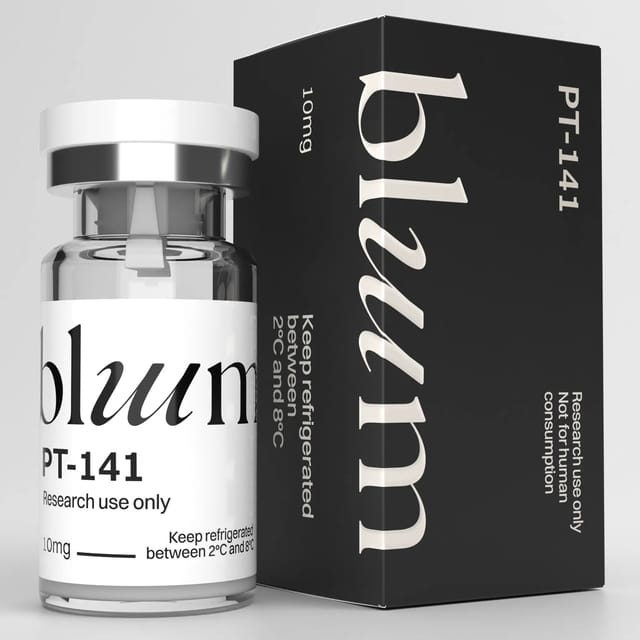
PT-141
$35.00
Melanotan I
$39.00


Bluum Peptides supplies these compounds for laboratory research. Every lot is tested by an independent lab before it ships, and each lab report can be looked up by lot number in the COA library. For research use only; not for human or veterinary use.


