

PT-141 (bremelanotide; CAS 189691-06-3) is a cyclic synthetic heptapeptide melanocortin receptor agonist (molecular formula C50H68N14O10, molecular weight 1,025.2 g/mol) supplied lyophilized for central melanocortin and neuroendocrine signaling research. Bluum Peptides stocks 10 mg vials ($35), with current lot PT102610-160A tested at 99.94% HPLC purity (9.37 mg measured) plus passing endotoxin, sterility, and heavy-metals panels by Freedom Diagnostics in the lab report library.
Chemically, PT-141 is the C-terminal free-acid analogue of Melanotan II. Replacing the terminal amide with a carboxylic acid shifts its GPCR activation profile toward central MC4R and MC3R pathways while preserving the cyclic stability of the lactam-bridged heptapeptide ring.
For analytical laboratories, sourcing PT-141 requires strict lot-level verification: confirming the 1,025.2 g/mol exact mass to separate it from Melanotan II (1,024.18 g/mol), checking measured mg fill weight, and auditing endotoxin, sterility, and heavy-metals coverage before initiating receptor assays.
What is PT-141 peptide (bremelanotide)?
PT-141 peptide (also cataloged as bremelanotide, PubChem CID 9941379, UNII 6Y24O4F92S) is a seven-amino-acid cyclic synthetic peptide derived from the core pharmacophore of alpha-melanocyte-stimulating hormone (alpha-MSH). Its sequence is Ac-Nle-cyclo[Asp-His-D-Phe-Arg-Trp-Lys]-OH, featuring an intramolecular lactam bridge between the aspartate and lysine side chains.
PT-141 originated from metabolic and structure-activity studies of cyclic melanocortin analogues. Investigators discovered that hydrolyzing the C-terminal amide of Melanotan II to a free carboxylic acid produced a distinct compound with focused affinity for central melanocortin receptors.
Solid-phase peptide synthesis (SPPS) builds the protected linear heptapeptide, selectively deprotects the aspartate and lysine side chains to close the lactam ring, cleaves the peptide from resin, and isolates the target product by preparative RP-HPLC before lyophilization.
How does PT-141 interact with melanocortin receptors in laboratory models?
In preclinical and in-vitro pharmacology, PT-141 activates melanocortin receptors belonging to the Class A G-protein-coupled receptor (GPCR) family, primarily MC4R with secondary activity at MC3R. Receptor engagement initiates a Gs-coupled adenylyl cyclase signal, elevating intracellular cyclic AMP (cAMP) and activating downstream protein kinase A pathways.
Because endogenous alpha-MSH is a linear 13-residue peptide that degrades rapidly in biological matrices, laboratories use lactam-cyclized synthetic peptides such as PT-141 as proteolytically resistant reference ligands. The cyclic scaffold locks the His-D-Phe-Arg-Trp binding motif into an active turn geometry that sustains reproducible receptor occupancy in cell-based assays.
Published laboratory studies examine PT-141 in recombinant MC3R/MC4R binding assays, cAMP accumulation screens, receptor-selectivity panels, and central neuroendocrine signaling models. Results depend on cell line receptor density, assay buffer composition, and ligand concentration curves.
How does PT-141 compare with Melanotan II and endogenous alpha-MSH?
PT-141, Melanotan II, and native alpha-MSH share the core melanocortin binding sequence but differ sharply in structure, stability, and receptor specificity. Confirming which analogue is on the bench prevents misinterpreting MC1R versus MC4R signaling data.
PT-141 (bremelanotide)
Verdict: Lactam-cyclized 7-residue free-acid melanocortin agonist (CAS 189691-06-3, 1,025.2 g/mol) prioritized for central MC4R and MC3R signaling assays.
- Best for: Selective MC4R/MC3R GPCR signaling, cAMP response kinetics, and central neuroendocrine pathway models.
- Analytical risk: Only 1.0 Da heavier than Melanotan II; low-resolution identity methods cannot separate the C-terminal free acid from the amidated species.
- Bluum pricing: 10 mg vial at $35 ($33.25 for 5+, $31.50 for 10+) on the PT-141 product page.
Melanotan II (MT-2)
Verdict: Lactam-cyclized 7-residue C-terminally amidated analogue (CAS 121062-08-6, 1,024.18 g/mol) with broad multi-receptor activity across MC1R, MC3R, MC4R, and MC5R.
- Best for: Multi-receptor melanocortin interaction models and MC1R-driven melanogenesis assays.
- Analytical risk: Broader receptor cross-reactivity makes isolating a single central pathway more difficult than with PT-141.
- Bluum pricing: 10 mg vial at $39 ($37.05 for 5+, $35.10 for 10+) on the Melanotan II product page.
| Parameter | PT-141 (Bremelanotide) | Melanotan II (MT-2) | Alpha-MSH (Endogenous) |
|---|---|---|---|
| CAS number | 189691-06-3 | 121062-08-6 | 581-05-5 |
| Amino acid length | 7 AA (cyclic) | 7 AA (cyclic) | 13 AA (linear) |
| C-terminal group | Free acid (-OH) | Amide (-NH2) | Amide (-NH2) |
| Molecular weight | 1,025.2 g/mol | 1,024.18 g/mol | 1,664.9 g/mol |
| Primary receptor targets | MC4R (primary), MC3R (secondary) | MC1R, MC3R, MC4R, MC5R | MC1R through MC5R |
| Assay proteolytic stability | High (lactam-cyclized) | Moderate to high (cyclized) | Lower (rapid enzymatic cleavage) |
How do independent labs verify PT-141 identity, purity, and full-panel quality?
Because PT-141 and Melanotan II differ by a single mass unit, third-party labs verify PT-141 by combining high-resolution LC-MS identity (1,025.2 g/mol) with RP-HPLC purity and quantitative assay of actual vial mass. Full-panel lots also undergo LAL endotoxin (USP <85>), microbial PCR sterility screening, and ICP-MS heavy-metals analysis.
Inspecting five consecutive Bluum Peptides 10 mg PT-141 lots across three independent labs shows how per-lot testing documents real batch variation in both purity and measured fill mass:
| Format and lot | Independent lab | Report # and date | HPLC purity | Measured content | Published panels |
|---|---|---|---|---|---|
| 10 mg (PT102610-160A, current) | Freedom Diagnostics | 2610260446 (2026-10-27) | 99.94% | 9.37 mg | COA, endotoxin, sterility, heavy metals |
| 10 mg (DPS-4394418, archived) | Horizon Analytical | 1026641 (2026-08-29) | 99.2% | 10.12 mg | COA, LAL endotoxin |
| 10 mg (PT102606-101K, archived) | Freedom Diagnostics | 2607010190 (2026-07-03) | 99.84% | 9.42 mg | COA, LAL endotoxin |
| 10 mg (PT102606-107A, archived) | Horizon Analytical | 102606107 (2026-06-24) | 99.21% | Not listed on summary | COA, LAL endotoxin |
| 10 mg (513212, archived) | BioRegen | 11197 (2025-10-23) | 99.82% | 11.3 mg | COA, LAL endotoxin |
Notice the measured content column across lots: 9.37 mg, 9.42 mg, 10.12 mg, and 11.3 mg for nominal 10 mg vials. Using the lot's measured mass (9.37 mg on current lot PT102610-160A) instead of assuming an exact 10.00 mg fill keeps nanomolar GPCR concentration curves accurate between runs.
Why do chromatographic purity and net peptide content differ for PT-141?
RP-HPLC purity reports the percentage of peptide-related UV absorbance belonging to the PT-141 peak, while net peptide content reports what fraction of the total lyophilized mass is active peptide rather than counterion salts and bound moisture. PT-141 is supplied as a salt form (commonly acetate or trifluoroacetate) due to its basic arginine, histidine, and lysine-related ionic equilibria.
Always review both the HPLC purity percentage and the measured mg assay on the batch COA before computing molar stock concentrations. If primary cell assays show sensitivity to residual trifluoroacetate (TFA), check salt form documentation prior to plating.
Why is PT-141 supplied lyophilized, and how should laboratories store it?
Freeze-drying PT-141 removes free water, arresting amide hydrolysis and tryptophan oxidation during domestic transit and inventory storage. Keep sealed dry vials cold, dark, and dry: Bluum product specifications list <=20 degrees C sealed away from heat, light, and moisture, and laboratories typically hold long-term dry reference stock at -20 degrees C.
Let refrigerated or frozen vials reach ambient temperature before breaking the seal so moisture does not condense on the dry cake. Evaluate solvent compatibility, container adsorption, and solution stability strictly under your laboratory's validated institutional methods and lot documentation.
What in-vitro study controls apply to PT-141 signaling assays?
Include solvent-matched vehicle controls, multi-point concentration-response curves across log-spaced dilutions, and receptor-negative control cells to distinguish specific MC4R/MC3R activation from nonspecific GPCR or buffer artifacts. When comparing PT-141 against Melanotan II, run both compounds from COA-verified lots at matched molar concentrations rather than nominal vial weights.
For sensitive cell cultures, verify lot-level endotoxin and sterility screening prior to assay setup. Current Bluum lot PT102610-160A carries full Freedom Diagnostics panels covering COA purity/assay, LAL endotoxin, PCR sterility, and heavy metals under report 2610260446.
How should laboratories evaluate a PT-141 research peptide supplier?
Require a batch-specific third-party COA matching the exact lot printed on the vial before ordering. Confirm four analytical elements: RP-HPLC chromatogram, LC-MS identity at 1,025.2 g/mol (confirming free-acid PT-141 rather than amidated MT-2), measured vial content, and endotoxin/sterility testing for cell-culture work.
Verify the accession number directly on the testing laboratory's portal (such as FreedomDiagnosticsTesting.com or horizonanalytical.com). Review all current and archived PT-141 reports on the PT-141 product page or in the lab report library; in-stock U.S. orders placed before 1 p.m. CT ship the same business day.
Frequently asked questions
What is PT-141 peptide?
PT-141 (bremelanotide, CAS 189691-06-3, 1,025.2 g/mol) is a synthetic lactam-cyclized heptapeptide melanocortin agonist with the formula C50H68N14O10. Laboratories use it as a lyophilized research reagent in MC4R/MC3R GPCR signaling and neuroendocrine pathway studies.
How does PT-141 differ from Melanotan II?
PT-141 carries a free C-terminal carboxylic acid (-OH, 1,025.2 g/mol), whereas Melanotan II carries a C-terminal amide (-NH2, 1,024.18 g/mol). That single functional-group difference narrows receptor focus toward MC4R and MC3R compared with Melanotan II's broader MC1R-to-MC5R binding profile.
What tests are published for Bluum's current PT-141 lot?
Current 10 mg lot PT102610-160A (Freedom Diagnostics report 2610260446, dated 2026-10-27) tested at 99.94% HPLC purity with 9.37 mg measured content, accompanied by published LAL endotoxin, sterility, and heavy-metals reports in Bluum's lab report library.
How should lyophilized PT-141 be stored?
Follow the vial label and batch documentation. Store sealed dry vials protected from heat, light, and moisture (<=20 degrees C per product label, or -20 degrees C for long-term dry reference storage), and equilibrate cold vials before opening.
Is Bluum's PT-141 research peptide for clinical or non-laboratory use?
No. PT-141 supplied by Bluum Peptides is sold strictly as a laboratory research chemical. It is not formulated, manufactured, or documented for clinical, diagnostic, or veterinary administration.
Disclaimer: All compounds discussed here, including any referenced products, are sold strictly for controlled laboratory research use only. They are not for clinical, diagnostic, or veterinary applications, and nothing here provides instructions outside a controlled research setting.
Compounds referenced in this article
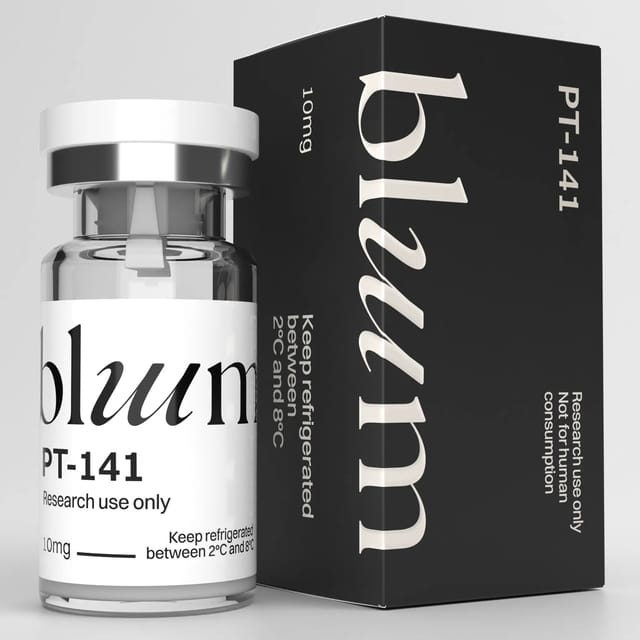
PT-141
$35.00
Melanotan II
$39.00

Bluum Peptides supplies these compounds for laboratory research. Every lot is tested by an independent lab before it ships, and each lab report can be looked up by lot number in the COA library. For research use only; not for human or veterinary use.


