Research Peptides: A Laboratory Buyer's Guide to Quality, Documentation, and Handling
Written by Tim J
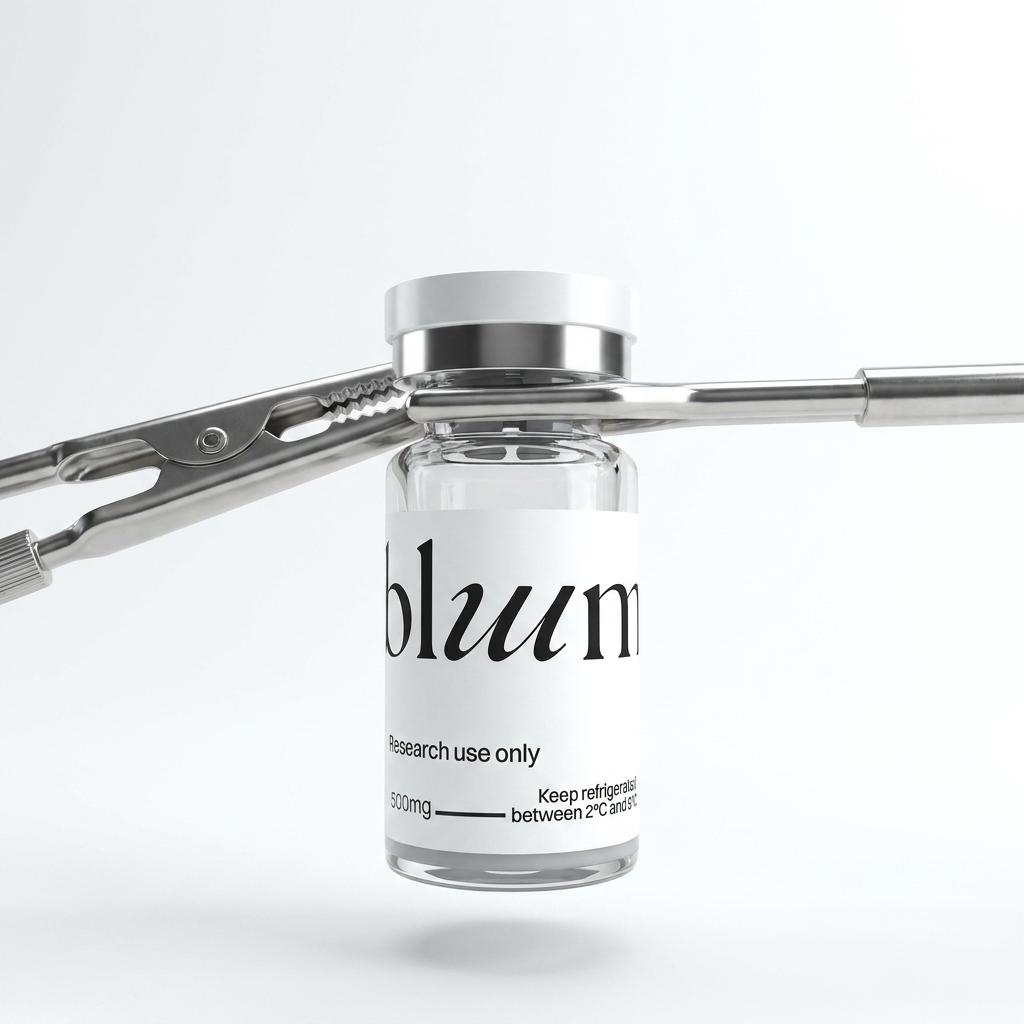
Research peptides are synthetic chains of amino acids, typically shorter than full proteins, manufactured and supplied strictly as reference materials for laboratory and in-vitro investigation. They are not medicines, supplements, or consumer products, and material labeled research use only is not authorized for human or veterinary application of any kind. What defines the category is not what a compound is believed to do, but how completely its identity, purity, and composition can be documented.
The practical problem for a procurement scientist is that the word "peptide" on a label tells you almost nothing. Two vials with identical labels can differ in what fraction of the powder is the target peptide and whether the contents match the certificate.
How Synthetic Research Peptides Are Made
Nearly all commercially available research peptides are produced by solid-phase peptide synthesis, which builds the chain one amino acid at a time while the growing peptide stays anchored to an insoluble resin bead. Each cycle removes a chemical protecting group, couples on the next amino acid, and washes excess reagent away.
When the sequence is complete, the peptide is cleaved from the resin and side-chain protecting groups are stripped. What comes off is crude peptide: the target plus close relatives, including chains that failed to couple at one position (deletion sequences), chains carrying an extra residue, incompletely deprotected species, and oxidized variants. Crude material is then purified, most commonly by reversed-phase HPLC, which separates the target by hydrophobicity. Fractions are collected, analyzed, pooled, and lyophilized into the dry powder that ships in the vial.
Two points matter to a buyer. Longer sequences are harder to make cleanly, because small per-cycle inefficiencies compound across many couplings. And purification method determines which impurities are actually removed: a single pass on one chromatographic method can leave co-eluting impurities that an orthogonal method would separate.
The Major Research Classes at a Glance
Research peptides are usually grouped by the pathway or receptor family the literature investigates. The table below describes what is studied in the laboratory, not any claimed outcome in a living subject.
| Research Class | What Characterizes It | Typical Laboratory Investigation |
|---|---|---|
| Incretin and metabolic-signaling peptides | Analogs and multi-receptor constructs related to gut-derived signaling hormones. | In-vitro receptor binding and selectivity, second-messenger signaling in transfected cell lines. |
| Growth-factor and secretagogue peptides | Releasing-hormone analogs and secretagogue sequences engaging pituitary-axis receptors. | Receptor activation assays, signaling cascade characterization, structure-activity relationships. |
| Cytoprotective and signaling fragments | Short fragments of larger endogenous proteins, studied as discrete sequences. | Cell-culture stress-response models, migration and adhesion assays, fragment stability work. |
| Melanocortin-pathway peptides | Sequences with characterized affinity for melanocortin receptor subtypes. | Subtype selectivity profiling, competitive binding assays, ligand-receptor structural studies. |
Multi-receptor constructs in the incretin class draw particular in-vitro interest because they let researchers compare selectivity across related receptor families in one molecule. Whichever class a lab works in, the framework below applies identically.
Reading a Certificate of Analysis Properly
The certificate of analysis is the most important document in this category and the most commonly misread. The core error is treating the HPLC purity percentage as though it describes the contents of the vial. It does not.
Chromatographic Purity Is Not Net Peptide Content
Chromatographic purity describes the target as a proportion of the peptide-related material detected by the method. It says nothing about non-peptide material in the powder.
Net peptide content answers a different question: of the total dry weight in the vial, what proportion is actually peptide? The remainder is counterion, residual water, and residual salts. A lab calculating concentrations from vial weight alone will systematically misstate its working concentrations.
What the Counterion Contributes
Synthetic peptides are isolated as salts, picking up counterions from the mobile phase during purification: commonly trifluoroacetate where trifluoroacetic acid is the ion-pairing agent, or acetate after a salt-exchange step. That counterion is part of the powder weight. It is a normal component, not an adulterant, but it must be accounted for in weight-based calculations.
Identity Confirmation
Purity establishes that a sample is homogeneous. It does not establish that the homogeneous species is the correct molecule. Identity is confirmed by molecular weight determination using MS analysis, comparing the observed molecular weight against the theoretical value calculated from the stated sequence. Look for both values on the certificate.
Water Content and Endotoxin
Lyophilized peptides are hygroscopic and retain residual water. Water content, typically by Karl Fischer titration or loss on drying, is part of the weight accounting that reconciles net peptide content against fill weight, and high residual moisture shortens shelf life.
Endotoxins are bacterial cell wall components that can confound cell-culture and immunological assays by triggering signaling independent of the peptide under study. For purely analytical workflows the data may be irrelevant; for cell-based assays it separates clean data from artifact.
| COA Field | What It Tells You | What It Does Not Tell You | Why It Matters |
|---|---|---|---|
| HPLC purity (%) | Target as a fraction of detected peptide-related species under one method. | How much of the vial's weight is peptide, or whether impurities co-elute. | The most over-interpreted number. Meaningless without the method. |
| Net peptide content (%) | Peptide as a fraction of total dry weight after counterion, water, and salts. | Whether the peptide present is the correct sequence. | Required for accurate concentration calculations from weight. |
| Molecular weight confirmation (MS analysis) | Observed molecular weight versus theoretical value for the stated sequence. | Quantity, purity, or non-peptide contaminants. | The only field confirming identity. |
| Counterion / salt form | Which salt the peptide was isolated as. | Counterion stoichiometry unless separately quantified. | Affects weight-based calculations and sensitive assays. |
| Water content | Residual moisture in the lyophilized cake. | Whether material was stored correctly after testing. | Feeds the weight accounting; correlates with stability. |
| Endotoxin | Bacterial endotoxin burden, when tested. | Sterility or other biological contaminants. | Critical for cell-based assays, often irrelevant analytically. |
| Lot / batch number | Which production run the vial came from. | Anything about quality on its own. | The hook that makes every other field verifiable. |
| Method and test date | How and when measurements were made. | Current condition of material tested long ago. | Without them it is an assertion, not a measurement. |
What Third-Party Testing Does and Does Not Prove
Independent testing is a genuine quality signal and is also routinely oversold. It establishes that a specific sample, tested at a specific time by a specific method, produced a specific result. What it does not establish:
- That the tested sample represents your vial. A report with no lot number, or one that does not match your label, describes somebody else's material.
- That every lot performs the same. Consistency is a pattern across lots, not one favorable report reused indefinitely.
- That the material is unchanged today. Testing captures a moment; storage and shipping happen afterward.
- That anything outside the scope was screened. A purity and identity panel does not cover residual solvents, heavy metals, or microbial content unless those assays were run.
A matching lot number, stated method, legible chromatogram, and a date make a report evidence. A generic PDF with no lot linkage is marketing.
Lot Traceability and Batch-to-Batch Consistency
Every vial should carry a lot number, that number should appear on the certificate, and the supplier should produce documentation for that specific lot on request.
Batch-to-batch consistency determines whether results stay comparable over time. If a lab characterizes a response on lot A and continues on lot B with a different impurity profile, apparent shifts may trace to the material rather than the experiment. Record the lot number alongside every result, and for multi-month studies, reserve enough material from one lot to cover the critical comparisons.
Lyophilization Cake Quality as a Visual QC Signal
Well-lyophilized peptide typically presents as a uniform, intact cake or consistent fluffy powder, reflecting a controlled freeze-drying cycle. Deviations worth logging on receipt:
- Collapsed, shrunken, or glassy cake. Often indicates the cycle ran above the collapse temperature, or a thermal excursion afterward.
- Visible moisture, stickiness, or a gummy film. Suggests water ingress from a compromised seal or from opening a cold vial too early.
- Discoloration. Well-made lyophilized peptide is typically white to off-white; yellowing warrants a question.
Appearance is a screening signal, not a verdict: a perfect cake can still be the wrong molecule.
Red Flags When Evaluating a Supplier
- No lot-specific certificate. A generic or undated document tied to nothing provides no assurance.
- Purity claims with no stated method. A percentage without a method is not a measurement.
- No identity confirmation. Purity data alone leaves the fundamental question open.
- Marketing that drifts toward human use. A supplier implying application in people is signaling poor compliance discipline. Walk away rather than negotiate.
- Absent chromatograms. Reputable documentation includes the trace, so a chemist can inspect peak shape and the impurity envelope.
- No answers to technical questions. A supplier who cannot discuss counterion, net peptide content, or purification probably does not control those variables.
- Inconsistent labeling. Sequence, molecular weight, and fill weight should agree across label and certificate.
Questions to Ask Before Ordering
- Will I receive the certificate for the exact lot shipped, and can I see it first?
- What method determined purity, and is a chromatogram included?
- What is the net peptide content, and what counterion is the material supplied as?
- How was identity confirmed, and are theoretical and observed molecular weights both reported?
- Has this lot been endotoxin tested, and is testing available on request?
- How is material stored before shipping, and how is it shipped?
- For a multi-month study, can a single lot be reserved?
Reconstitution and Storage Fundamentals
The following covers laboratory handling of the material itself. It is stability and technique guidance for benchwork, not guidance for any application to a living subject.
Solvent Selection Rationale
Solvent choice follows the peptide's own chemistry: net charge at a given pH and overall hydrophobicity, both set by amino acid composition. Hydrophilic sequences usually dissolve readily in sterile water or an appropriate buffer. Hydrophobic sequences may resist aqueous solvent entirely and need an organic co-solvent for initial dissolution before dilution into the working system. Test solubility on a small portion first, and add solvent gently: agitation creates air-liquid interfaces that promote aggregation and adsorption.
Temperature
Lyophilized peptide is far more stable than peptide in solution, which is why material ships and stores dry, conventionally at freezer temperature. Reconstituted material is a short-lived working preparation kept refrigerated, with frozen storage for anything held longer. Always let a cold vial reach room temperature before opening; opening cold invites atmospheric moisture to condense onto the hygroscopic cake, the most common avoidable handling error in the category.
Protection From Light
Tryptophan, tyrosine, and the sulfur-containing residues are susceptible to photodegradation and oxidation. Amber vials, foil wrapping, or storing in the dark mitigates this.
Freeze-Thaw Cycles and Aliquoting
Repeated freezing and thawing degrades peptide in solution, exposing the molecule to concentration changes, ice-crystal shear, and pH shifts as buffer components crystallize at different rates. The defense is aliquoting: on reconstitution, divide into single-use volumes, label each with compound, concentration, lot number, and date, and thaw only what a run requires. That removes freeze-thaw as a variable and builds the lot-linked record that keeps results traceable.
The Research-Use-Only Reality in the United States
Research use only is a regulatory status, not a marketing phrase. In the United States, material designated research use only is intended for laboratory investigation and is not an approved drug, supplement, food ingredient, or device. It has not been evaluated for safety or effectiveness in humans or animals and is not authorized for diagnostic, therapeutic, or clinical use.
Suppliers are expected to label materials clearly and avoid any representation, direct or implied, suggesting use in people. Purchasers are expected to be qualified parties acquiring material for legitimate laboratory purposes under the governance applicable to their setting. Marketing conduct is a reliable proxy for operational discipline.
Frequently Asked Questions
What are research peptides?
Research peptides are synthetic chains of amino acids, generally shorter than full-length proteins, manufactured for use as reference materials and reagents in laboratory and in-vitro research. They are supplied as lyophilized powder with documentation covering identity and purity, and they are designated research use only, meaning they are not approved or authorized for human or veterinary use of any kind.
What is the difference between HPLC purity and net peptide content?
HPLC purity expresses the target peptide as a percentage of the peptide-related material detected by chromatography. Net peptide content expresses peptide as a percentage of total dry weight, accounting for counterions, residual water, and salts. A vial can show high chromatographic purity while a meaningful share of its fill weight is non-peptide material, so concentration calculations based on weight require net peptide content, not purity.
Why does the counterion matter on a certificate of analysis?
Synthetic peptides are isolated as salts, and the counterion, commonly trifluoroacetate or acetate depending on purification and any salt-exchange step, forms part of the powder's weight. It is a normal component rather than a contaminant, but it must be accounted for in weight-based concentration calculations. Some analytical and cell-based systems are also sensitive to counterion identity, which is why a complete certificate states the salt form explicitly.
How is the identity of a research peptide confirmed?
Identity is confirmed by molecular weight determination using MS analysis, comparing the observed molecular weight of the material against the theoretical molecular weight calculated from the stated amino acid sequence. Agreement supports that the material is the intended molecule. Purity data alone confirms only that a sample is homogeneous, not that the homogeneous species is correct, so a complete certificate reports both.
Does third-party testing guarantee peptide quality?
No. Third-party testing establishes that one specific sample, tested at one point in time by one stated method, produced a specific result. It does not prove that the tested sample matches the lot you received, that other lots perform identically, that the material is unchanged after storage and shipping, or that anything outside the assay's scope was screened. A third-party report is meaningful only when it carries a lot number matching your vial, a stated method, and a date.
How should lyophilized research peptides be stored in the laboratory?
Lyophilized peptide is substantially more stable than peptide in solution and is conventionally stored frozen, protected from light, and sealed against moisture, since the powder is hygroscopic. Vials should reach room temperature before opening so atmospheric moisture does not condense onto the cake. Once reconstituted, solutions are best divided into single-use aliquots labeled with compound, concentration, lot number, and date, so repeated freeze-thaw cycles are avoided.
Research Use Only Disclaimer
All materials and information described on this page are intended strictly for laboratory research use only. Research peptides discussed here are not drugs, foods, cosmetics, supplements, or medical devices, and they are not approved or authorized by any regulatory authority for human or veterinary use. They must not be administered to humans or animals under any circumstances. Nothing in this article constitutes medical advice, a therapeutic claim, a statement of safety or efficacy, or any guidance for use in living subjects. These materials are supplied exclusively to qualified researchers, institutions, and laboratory professionals for in-vitro investigation and analytical purposes, and purchasers are solely responsible for handling, storing, and using them in compliance with all applicable laws, regulations, and institutional safety requirements.