

Glutathione (reduced L-glutathione, GSH; CAS 70-18-8) is an endogenous gamma-linked tripeptide composed of glutamate, cysteine, and glycine (molecular formula C10H17N3O6S, molecular weight 307.32 g/mol) supplied lyophilized for cellular redox, oxidative stress, and enzymology research. Bluum Peptides stocks 500 mg ($55, lot GLU52607-122A at 99.54% purity), 1,200 mg ($69, lot GLU122605-80L at 99.47% purity), and 1,500 mg ($59, lot GLU152608-124K at 99.71% purity, 1,538.34 mg measured) vials in the lab report library.
Unlike standard alpha-linked peptides, glutathione joins glutamate to cysteine through glutamate's gamma-carboxyl group. That unusual gamma-peptide bond resists cleavage by ordinary intracellular peptidases while positioning cysteine's free thiol (-SH) group as a primary cellular redox buffer.
In laboratory work, thiol oxidation is the defining quality-control risk. Exposure to oxygen, trace transition metals, or alkaline buffers oxidizes reduced GSH (307.32 g/mol) into glutathione disulfide (GSSG, 612.63 g/mol), making lot-matched HPLC and LC-MS verification mandatory before running redox assays.
What is glutathione peptide (GSH)?
Glutathione peptide (L-glutathione reduced, GSH; PubChem CID 124886, CAS 70-18-8, MW 307.32 g/mol) is a low-molecular-weight tripeptide built from three amino acids: L-glutamic acid, L-cysteine, and glycine (gamma-L-Glu-L-Cys-Gly). Inside cells, glutamate-cysteine ligase and glutathione synthetase assemble GSH enzymatically rather than on ribosomes.
Two structural traits drive glutathione's biochemical behavior in vitro. First, the gamma-glutamyl linkage protects the molecule from standard aminopeptidases, leaving gamma-glutamyltransferase (GGT) as its primary hydrolytic enzyme. Second, the nucleophilic cysteine sulfhydryl (-SH) participates directly in reversible redox chemistry and enzymatic conjugation reactions.
When reviewing certificates of analysis or vendor catalogs, always verify that the specified molecule is reduced L-glutathione (GSH, CAS 70-18-8, 307.32 g/mol) rather than oxidized glutathione disulfide (GSSG, CAS 27025-41-8, 612.63 g/mol).
What laboratory research contexts investigate glutathione?
In vitro and biochemical studies rely on reduced glutathione across four core research areas: cellular redox buffering, antioxidant enzyme kinetics, phase-II conjugation (detoxification) enzymology, and pigment-pathway biochemistry.
In oxidative stress and redox-biology models, GSH donates electrons to neutralize reactive oxygen species and organic peroxides through glutathione peroxidases (GPx), generating GSSG that glutathione reductase recycles back to GSH using NADPH. Measuring the intracellular GSH/GSSG ratio is a standard quantitative benchmark of oxidative stress in cultured cells and tissue homogenates.
In enzymology, laboratories use GSH as the obligatory nucleophilic cosubstrate for glutathione S-transferases (GSTs), which catalyze conjugation of electrophilic substrates in model detoxification assays. Separately, melanogenesis biochemistry studies examine how free cysteine thiols such as GSH react with dopaquinone intermediates in cell-free and melanocyte assays to shift biosynthetic flux between eumelanin and pheomelanin pathways.
How does reduced glutathione (GSH) compare with GSSG and NAD+?
Laboratories modeling cellular redox states distinguish carefully between reduced GSH, oxidized GSSG, and pyridine nucleotide coenzymes such as NAD+. While both redox couples regulate cellular energy and oxidative balance, they operate through distinct chemical mechanisms and enzyme families.
Reduced L-Glutathione (GSH)
Verdict: Free-thiol gamma-tripeptide (CAS 70-18-8, 307.32 g/mol) serving as the primary cytosolic thiol redox buffer and cosubstrate for GPx and glutathione S-transferases.
- Best for: GSH/GSSG calibration curves, GPx and GST enzyme kinetics, free-radical scavenging assays, protein S-glutathionylation models, and oxidative-stress cell culture controls.
- Analytical risk: Free cysteine thiol oxidizes readily into GSSG dimer (612.63 g/mol) in oxygenated or metal-contaminated solutions; verify low GSSG peak area on the batch HPLC chromatogram.
- Bluum pricing: 500 mg at $55 ($52.25 for 5+, $49.50 for 10+), 1,200 mg at $69 ($65.55 for 5+, $62.10 for 10+), and 1,500 mg at $59 ($56.05 for 5+, $53.10 for 10+) on the Glutathione product page.
Oxidized Glutathione (GSSG)
Verdict: Disulfide-linked dimer of two glutathione molecules (CAS 27025-41-8, 612.63 g/mol) lacking free thiol reactivity.
- Best for: Glutathione reductase (GR) substrate kinetics, oxidized-control standards in DTNB/Ellman recycling assays, and oxidative-shift reference curves.
- Analytical risk: Chemically inactive as a GPx or GST reducing cosubstrate; inadvertently using oxidized GSH stock invalidates thiol-dependent assays.
NAD+ (Nicotinamide Adenine Dinucleotide)
Verdict: Oxidized pyridine dinucleotide coenzyme (CAS 53-84-9, 663.43 g/mol) governing metabolic electron transfer, sirtuins, and PARP enzymes alongside the linked NADP+/NADPH system that regenerates GSH.
- Best for: Dehydrogenase kinetics, mitochondrial bioenergetics, and sirtuin/PARP signaling studies.
- Bluum pricing: 500 mg ($57) and 1,000 mg ($109) vials on the NAD+ product page.
| Attribute | Reduced Glutathione (GSH) | Oxidized Glutathione (GSSG) | NAD+ |
|---|---|---|---|
| CAS number | 70-18-8 | 27025-41-8 | 53-84-9 |
| Molecular class | Gamma-linked tripeptide | Disulfide tripeptide dimer | Pyridine dinucleotide coenzyme |
| Molecular weight | 307.32 g/mol | 612.63 g/mol | 663.43 g/mol |
| Active functional group | Free cysteine thiol (-SH) | Disulfide bond (-S-S-) | Nicotinamide ring (hydride transfer) |
| Primary enzyme partners | GPx, glutathione S-transferases | Glutathione reductase | Dehydrogenases, sirtuins, PARPs |
| Primary redox role | Reducing agent / nucleophile | Oxidized disulfide product | Oxidized electron acceptor |
How do independent labs verify glutathione certificate of analysis data?
Independent testing laboratories verify reduced glutathione using RP-HPLC (or ion-pair HPLC) capable of resolving GSH from oxidized GSSG, combined with LC-MS mass confirmation at 307.32 g/mol. Because GSSG absorbs UV light differently from monomeric GSH and shifts molecular mass from 307.32 to 612.63 g/mol, pairing HPLC purity with LC-MS confirms the lot is genuinely reduced L-glutathione.
Inspecting active and archived Bluum Peptides lots across all three stocked vial formats (500 mg, 1,200 mg, and 1,500 mg) documents third-party consistency across Freedom Diagnostics, Horizon Analytical, and BioRegen:
| Format and lot | Independent lab | Report # and date | HPLC purity | Measured content / identity | Published panels |
|---|---|---|---|---|---|
| 1,500 mg (GLU152608-124K, current) | Freedom Diagnostics | 2608061104 (2026-08-11) | 99.71% | 1,538.34 mg; LC-MS identity confirmed | COA |
| 1,200 mg (GLU122605-80L, current) | Freedom Diagnostics | 2606240470 (2026-06-27) | 99.47% | Not listed on summary | COA, LAL endotoxin |
| 500 mg (GLU52607-122A, current) | Horizon Analytical | 1017781 (2026-07-12) | 99.54% | Not listed on summary | COA, LAL endotoxin |
| 1,500 mg (GLU15202605-80L, archived) | Freedom Diagnostics | 2606150690 (2026-06-18) | 99.60% | Not listed on summary | COA, LAL endotoxin |
| 1,500 mg (25092301, archived) | BioRegen | 12613 (2026-03-27) | 99.23% | 1,311 mg measured | COA |
Compare the two 1,500 mg measured-content entries above: archived BioRegen lot 25092301 measured 1,311 mg, whereas current Freedom Diagnostics lot GLU152608-124K measured 1,538.34 mg at 99.71% HPLC purity with LC-MS identity confirmed. Reviewing the exact lot report before preparing millimolar redox buffers keeps assay concentrations calibrated.
Why does thiol oxidation govern glutathione storage and handling?
Glutathione is supplied as a fine white-to-off-white crystalline lyophilized powder inside a sealed 10 mL glass vial because dry, oxygen-limited storage arrests autoxidation of its cysteine thiol group. In aqueous solution, dissolved oxygen and trace metal ions (iron or copper) catalyze rapid conversion of GSH to GSSG, particularly at neutral to alkaline pH.
Store sealed dry glutathione vials at -20 degrees C protected from light and moisture per Bluum product specifications. Equilibrate cold vials to ambient temperature before unsealing so moisture does not condense on the powder. Evaluate deoxygenated buffers, metal chelators (such as EDTA where compatible), buffer pH, and solution stability strictly under your laboratory's validated institutional methods.
What in-vitro controls and safety data apply to glutathione assays?
In quantitative cell-culture or cell-free redox studies, verify the free-thiol fraction of freshly prepared GSH stock using an Ellman's reagent (DTNB) check or an HPLC calibration run prior to assay start. Include GSSG-only and solvent-matched buffer controls to separate genuine thiol-reducing effects from pH or ionic-strength shifts, because unbuffered GSH solutions are distinctly acidic (pH ~3).
When culturing redox-sensitive or immune cell lines, verify lot-specific LAL endotoxin testing (published on Bluum's current 500 mg lot GLU52607-122A and 1,200 mg lot GLU122605-80L) and log the lot number and COA accession ID in your experimental record.
How should laboratories evaluate a third-party tested glutathione supplier?
Require a batch-specific certificate of analysis matching the exact lot code on the vial before ordering. Confirm four checkpoints: HPLC chromatogram demonstrating high monomeric GSH purity with minimal GSSG dimer, LC-MS identity matching 307.32 g/mol, measured vial mass where reported, and LAL endotoxin testing for cell-culture work.
Confirm accession numbers directly on the issuing lab's verification portal (FreedomDiagnosticsTesting.com or horizonanalytical.com). Bluum Peptides publishes active and archived glutathione lab reports on the Glutathione product page and in the lab report library, with same-business-day U.S. shipping on in-stock orders placed before 1 p.m. CT.
Frequently asked questions
What is glutathione peptide?
Glutathione (reduced L-glutathione, GSH; CAS 70-18-8, 307.32 g/mol) is an endogenous gamma-linked tripeptide made of glutamate, cysteine, and glycine (C10H17N3O6S). Laboratories use it as a lyophilized research reagent in cellular redox, oxidative stress, and enzyme-kinetics studies.
Why does glutathione resist cleavage by standard peptidases?
Glutamate connects to cysteine via its gamma-carboxyl group rather than its alpha-carboxyl group. This gamma-peptide bond prevents hydrolysis by most alpha-peptidases, restricting enzymatic cleavage primarily to gamma-glutamyltransferase (GGT).
What is the difference between GSH and GSSG?
GSH is monomeric reduced glutathione (307.32 g/mol) carrying a reactive free cysteine thiol (-SH). When oxidized, two GSH molecules form a disulfide bond to produce glutathione disulfide (GSSG, 612.63 g/mol), which no longer acts as a reducing thiol buffer.
How should lyophilized glutathione be stored?
Store sealed dry vials at -20 degrees C protected from light and moisture, following the vial label and batch documentation. Allow cold vials to equilibrate to room temperature before breaking the seal.
Is Bluum's glutathione research reagent intended for clinical, dietary, or non-laboratory use?
No. Glutathione supplied by Bluum Peptides is strictly a laboratory research chemical. It is not formulated, manufactured, or documented for clinical, dietary, cosmetic, diagnostic, or veterinary administration.
Disclaimer: All compounds discussed here, including any referenced products, are sold strictly for controlled laboratory research use only. They are not for clinical, diagnostic, or veterinary applications, and nothing here provides instructions outside a controlled research setting.
Compounds referenced in this article

Glutathione
From $55.00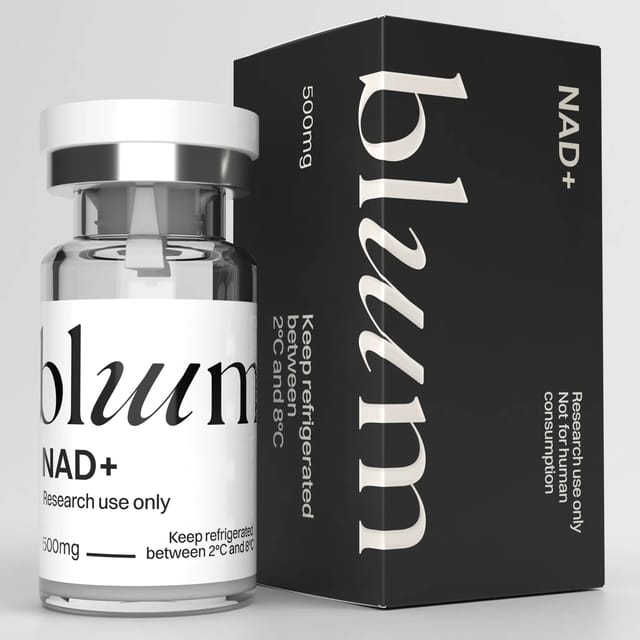
NAD+
From $57.00

Bluum Peptides supplies these compounds for laboratory research. Every lot is tested by an independent lab before it ships, and each lab report can be looked up by lot number in the COA library. For research use only; not for human or veterinary use.


