

NAD+ (nicotinamide adenine dinucleotide, Coenzyme I; CAS 53-84-9) is an oxidized pyridine dinucleotide coenzyme (molecular formula C21H27N7O14P2, molecular weight 663.43 g/mol) supplied as a lyophilized powder for cellular bioenergetics, redox, and enzymatic research. Bluum Peptides stocks 500 mg ($57, current lot DPS-5565049 at 99.53% HPLC purity by Horizon Analytical) and 1,000 mg ($109, current lot NAD1K2607-104K at 99.95% HPLC purity by Freedom Diagnostics) vials in the lab report library.
Although frequently searched as “NAD+ peptide” and cataloged alongside lyophilized research peptides, NAD+ is chemically a dinucleotide molecule rather than an amino acid chain. It consists of a nicotinamide mononucleotide unit joined by a pyrophosphate bridge to adenosine monophosphate.
At the bench, reagent reliability hinges on protecting the labile nicotinamide-ribosyl glycosidic bond from hydrolytic cleavage. Laboratories verify RP-HPLC purity against degradation products (nicotinamide and ADP-ribose), confirm identity at 663.43 g/mol, and keep lyophilized stock cold and dry.
What is NAD+, and why is it grouped with research peptide catalogs?
NAD+ (beta-nicotinamide adenine dinucleotide, PubChem CID 5892, CAS 53-84-9, MW 663.43 g/mol) is a ubiquitous intracellular coenzyme found in every living cell. Rather than consisting of peptide-bonded amino acids, NAD+ is a phosphorylated nucleotide cofactor built from adenine, nicotinamide, two ribose rings, and two phosphate groups.
Research suppliers routinely catalog lyophilized NAD+ alongside synthetic peptides because laboratories studying mitochondrial function, cellular aging pathways, and oxidative stress often run NAD+ coenzyme panels alongside mitochondria-targeted peptides such as SS-31 or redox tripeptides such as glutathione. Both product classes share freeze-dried vial packaging, cold-storage workflows, and third-party HPLC verification.
Distinguishing the oxidized cation (NAD+) from its reduced counterpart (NADH) matters before designing any spectrophotometric or enzymatic assay. Oxidized NAD+ absorbs strongly near 260 nm with negligible absorbance at 340 nm, whereas reduced NADH produces a distinct absorbance band at 340 nm used across dehydrogenase kinetic assays.
What cellular research contexts investigate NAD+?
In vitro and biochemical studies investigate NAD+ across two primary mechanistic roles: reversible electron transfer in energy production pathways and stoichiometric consumption as a substrate for NAD+-dependent regulatory enzymes.
In cellular bioenergetics and mitochondrial function models, NAD+ acts as the core hydride acceptor across glycolysis, the tricarboxylic acid (TCA) cycle, and fatty-acid beta-oxidation, cycling between NAD+ and NADH to drive mitochondrial electron transport and ATP synthesis. Measuring the intracellular NAD+/NADH ratio provides a direct quantitative readout of cellular redox state.
A second major research area examines NAD+-consuming enzyme families, specifically sirtuins (NAD+-dependent deacylases), poly(ADP-ribose) polymerases (PARP enzymes involved in DNA repair signaling), and CD38/CD157 ectoenzymes. In cell-culture and cell-free enzyme assays, NAD+ availability directly governs deacetylation kinetics, PARylation rates during cellular repair responses, and downstream metabolic transcription.
How does NAD+ compare with NADH, NMN, and NR in research models?
Laboratories studying pyridine nucleotide biology choose between direct NAD+, reduced NADH, and salvage-pathway precursors such as nicotinamide mononucleotide (NMN) and nicotinamide riboside (NR). Each molecule serves a distinct analytical role and cannot be substituted interchangeably in cell-free or intact-cell assays.
NAD+ (oxidized coenzyme)
Verdict: Oxidized pyridine dinucleotide cofactor (CAS 53-84-9, 663.43 g/mol) functioning directly as an electron acceptor and substrate for sirtuins and PARP enzymes.
- Best for: Cell-free dehydrogenase kinetics, sirtuin and PARP enzyme assays, intracellular NAD+/NADH standard curves, and extracellular nucleotide signaling studies.
- Analytical risk: Hydrolyzes into nicotinamide and ADP-ribose in warm or alkaline aqueous buffers; hygroscopic lyophilized powder requires low-temperature dry storage.
- Bluum pricing: 500 mg vial at $57 ($54.15 for 5+, $51.30 for 10+) and 1,000 mg vial at $109 ($103.55 for 5+, $98.10 for 10+) on the NAD+ product page.
NADH (reduced coenzyme)
Verdict: Two-electron reduced form of NAD+ (CAS 58-68-4, 665.44 g/mol) acting as the primary hydride donor for mitochondrial Complex I and biosynthetic reductases.
- Best for: Complex I oxidoreductase activity assays, 340 nm spectrophotometric kinetic standards, and reductive capacity modeling.
- Analytical risk: Rapidly degrades in acidic solutions and oxidizes on prolonged exposure to dissolved oxygen and light.
NMN and NR (salvage-pathway precursors)
Verdict: Smaller biosynthetic intermediates (NMN: 334.22 g/mol; NR: 255.25 g/mol) converted intracellularly into NAD+ through the nicotinamide salvage pathway.
- Best for: Intact-cell uptake modeling, NAMPT/NMNAT enzyme flux studies, and precursor-conversion kinetics where membrane permeability limits intact dinucleotide entry.
- Analytical risk: Inactive as direct cofactors in cell-free dehydrogenase or sirtuin reactions that require intact NAD+.
| Attribute | NAD+ | NADH | NMN / NR Precursors |
|---|---|---|---|
| Molecular class | Oxidized dinucleotide coenzyme | Reduced dinucleotide coenzyme | Mononucleotide / riboside precursor |
| CAS number | 53-84-9 | 58-68-4 | 1094-61-7 (NMN) / 1341-23-7 (NR) |
| Molecular weight | 663.43 g/mol | 665.44 g/mol | 334.22 g/mol (NMN) / 255.25 g/mol (NR) |
| Redox state | Oxidized (electron acceptor) | Reduced (electron donor) | Non-redox biosynthetic intermediate |
| UV absorbance marker | 260 nm (no 340 nm peak) | 260 nm and 340 nm | 260 nm (no 340 nm peak) |
| Primary lab role | Direct enzyme substrate and redox acceptor | Hydride donor and Complex I assay | Intact-cell salvage pathway flux |
How do independent labs verify NAD+ purity and lot quality?
Independent analytical laboratories quantify NAD+ purity by HPLC (monitoring UV absorbance near 260 nm) and verify molecular identity against 663.43 g/mol. Crucially, chromatographic separation checks for the two main hydrolytic breakdown products — free nicotinamide and adenosine diphosphate ribose (ADP-ribose) — as well as residual alpha-anomer impurities that are enzymatically inactive.
Reviewing active and archived Bluum Peptides NAD+ lots across Freedom Diagnostics and Horizon Analytical shows lot-specific batch purity ranging from 99.53% to 99.95% across both vial sizes:
| Format and lot | Independent lab | Report # and date | HPLC purity | Measured content / notes | Published panels |
|---|---|---|---|---|---|
| 1,000 mg (NAD1K2607-104K, current) | Freedom Diagnostics | 2607130759 (2026-07-16) | 99.95% | Not listed on summary | COA |
| 500 mg (DPS-5565049, current) | Horizon Analytical | 1027192 (2026-09-04) | 99.53% | 500 mg nominal (Pass) | COA, LAL endotoxin |
| 500 mg (DPS-1832105, archived) | Horizon Analytical | 1022608 (2026-08-04) | 99.60% | 518 mg measured | COA, LAL endotoxin |
| 1,000 mg (NAD1K2606-107A, archived) | Horizon Analytical | 12606107 (2026-06-24) | 99.55% | Not listed on summary | COA, LAL endotoxin |
Inspecting the published lot record also clarifies which panels accompany each specific vial size: for example, current 500 mg lot DPS-5565049 carries both COA and LAL endotoxin reports, while current 1,000 mg lot NAD1K2607-104K carries an HPLC COA (99.95%). Checking the exact lot on your vial ensures your experiment matches the testing panels required by your protocol.
Why do moisture, pH, and temperature control decide NAD+ stability?
NAD+ is supplied as a solid white lyophilized powder in a sealed 5 mL glass vial because dry-state freeze-drying slows cleavage of the nicotinamide-ribose bond. Unlike NADH (which is acid-labile and base-stable), oxidized NAD+ exhibits the opposite pH profile: it degrades rapidly in alkaline buffers above pH 8 and at elevated temperatures, releasing free nicotinamide that can act as a feedback inhibitor of sirtuins and PARP enzymes.
Store sealed dry NAD+ cold, dark, and dry: Bluum product specifications list -10 degrees C sealed away from heat, light, and moisture (and -20 degrees C is widely used for archival reference stock). Allow cold vials to reach room temperature before opening to prevent moisture uptake on the hygroscopic powder. Evaluate buffer pH, ionic strength, and working-solution stability strictly under your laboratory's validated methods and batch documentation.
What in-vitro controls and safety data apply to NAD+ assays?
Because hydrolyzed nicotinamide inhibits sirtuin and PARP catalytic sites, verify low baseline degradation before starting enzyme kinetics and include a nicotinamide-only control arm where sensitivity is high. In spectrophotometric assays, check 260 nm / 340 nm absorbance ratios to confirm the starting stock is oxidized NAD+ with minimal NADH contamination.
When working with primary mammalian cells or immune lines, check lot-level LAL endotoxin status before plating, and run matched buffer controls because unbuffered NAD+ acidifies aqueous solutions slightly due to its pyrophosphate groups. Log the exact lot code and COA accession ID in your lab notebook.
How should laboratories evaluate an NAD+ supplier?
Require a batch-specific third-party COA matching the exact lot code printed on the 500 mg or 1,000 mg vial before ordering. Confirm HPLC chromatographic purity (verifying separation from nicotinamide and ADP-ribose), identity verification, net content where reported, and LAL endotoxin documentation when running sensitive cell-culture models.
Verify report accession numbers directly on the issuing laboratory's verification portal (FreedomDiagnosticsTesting.com or horizonanalytical.com). Bluum Peptides publishes active and archived NAD+ documentation on the NAD+ product page and in the lab report library, with same-business-day U.S. shipping on in-stock orders placed before 1 p.m. CT.
Frequently asked questions
Is NAD+ actually a peptide?
No. NAD+ (nicotinamide adenine dinucleotide, CAS 53-84-9, 663.43 g/mol) is a pyridine dinucleotide coenzyme rather than an amino acid peptide. It is commonly listed alongside lyophilized research peptides because laboratories use it in overlapping mitochondrial and cellular redox assays.
What is the chemical difference between NAD+ and NADH?
NAD+ is the oxidized form that accepts two electrons and a proton (a hydride ion) during catabolic redox reactions, forming reduced NADH. NAD+ absorbs UV light near 260 nm without a 340 nm peak, whereas NADH displays a characteristic absorbance peak at 340 nm.
Why does alkaline pH degrade NAD+ in laboratory buffers?
Elevated pH and heat accelerate hydrolysis of the nicotinamide-ribosyl glycosidic bond in oxidized NAD+, generating free nicotinamide and ADP-ribose. Free nicotinamide can confound sirtuin and PARP enzyme assays by acting as a competitive feedback inhibitor.
How should lyophilized NAD+ be stored in the lab?
Follow the vial label and batch documentation. Bluum product specifications list dry sealed storage at -10 degrees C (or -20 degrees C for long-term archival stock), protected from heat, light, and moisture. Equilibrate sealed cold vials to room temperature before opening.
Is Bluum's NAD+ intended for clinical or non-laboratory applications?
No. NAD+ sold by Bluum Peptides is strictly a laboratory research chemical. It is not formulated, manufactured, or documented for clinical, dietary, diagnostic, or veterinary administration.
Disclaimer: All compounds discussed here, including any referenced products, are sold strictly for controlled laboratory research use only. They are not for clinical, diagnostic, or veterinary applications, and nothing here provides instructions outside a controlled research setting.
Compounds referenced in this article
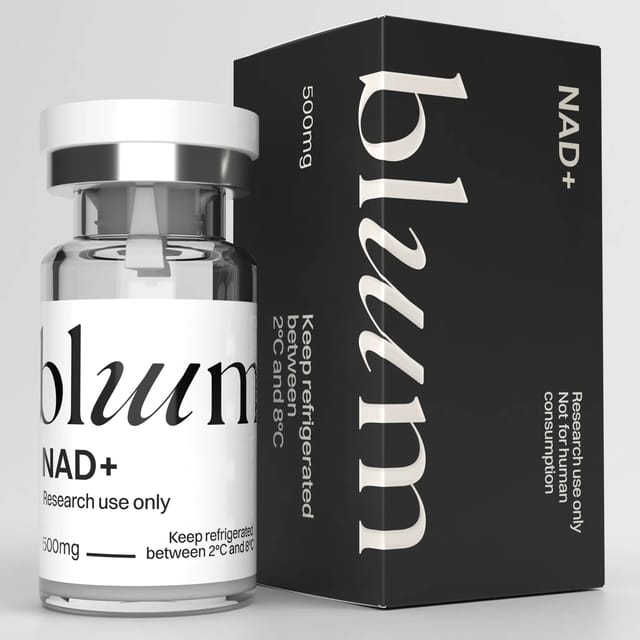
NAD+
From $57.00
Bluum Peptides supplies these compounds for laboratory research. Every lot is tested by an independent lab before it ships, and each lab report can be looked up by lot number in the COA library. For research use only; not for human or veterinary use.


