

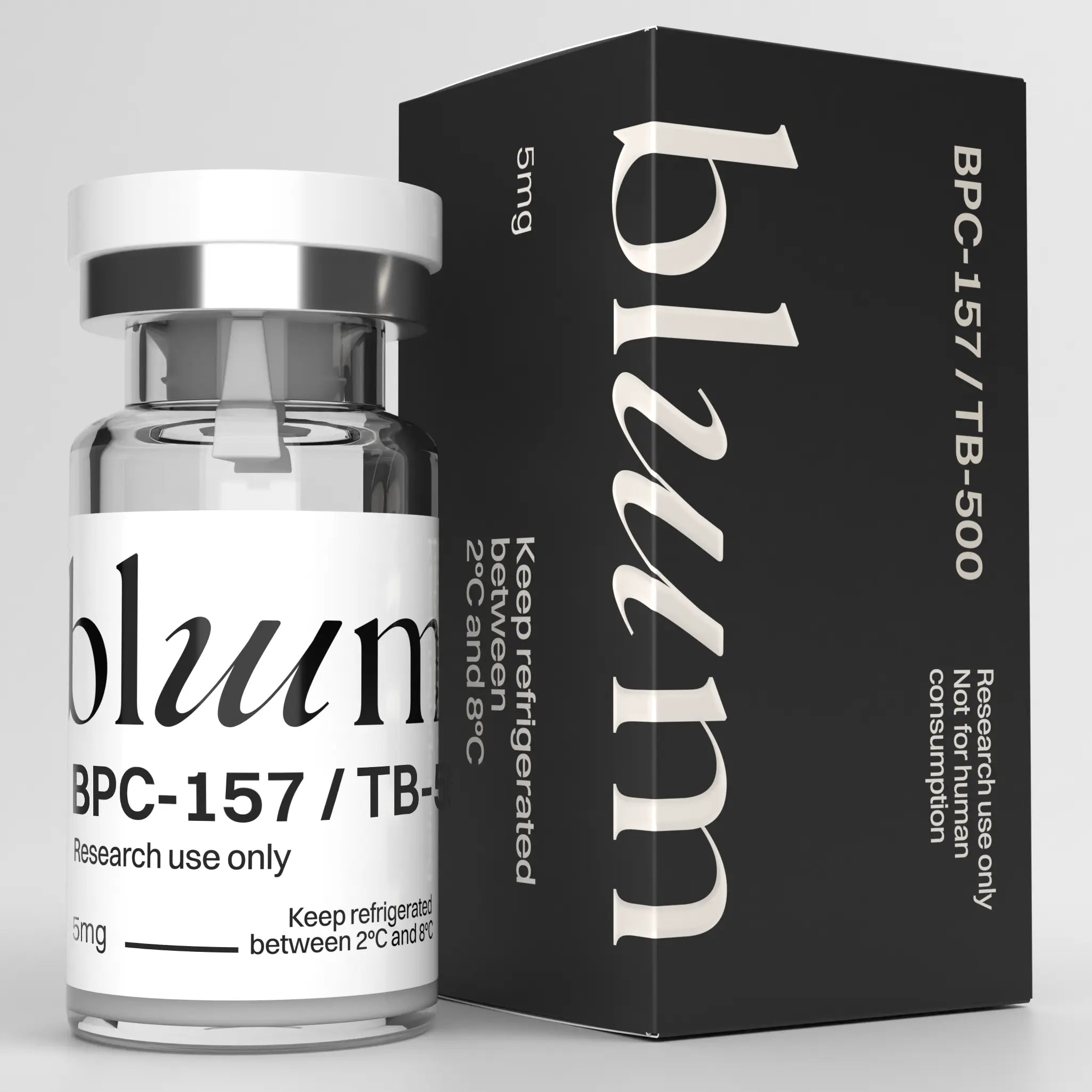
BPC-157 / TB-500
 Money Back
Guarantee
Money Back
Guarantee Satisfaction
Guarantee
Satisfaction
Guarantee Easy Returns
 Secure
Ordering
Secure
Ordering 2-Day
Shipping
2-Day
Shipping Third Party
Tested
Third Party
Tested Batch & Lot
Tracking
Batch & Lot
TrackingLab results
RESEARCH USE ONLY
These compounds are NOT intended for human consumption, clinical use, or veterinary applications. We are not affiliated with any pharmaceutical companies or their commercial medications. By placing an order, you certify these materials will be used exclusively for in vitro testing and laboratory experimentation only. Bodily introduction of any kind into humans or animals is strictly forbidden by law. This product should only be handled by licensed, qualified professionals. This product is not a drug, food, or cosmetic and may not be misbranded, misused or mislabeled as a drug, food or cosmetic.
About BPC-157 / TB-500
The BPC 157 TB 500 Blend is a pre-mixed research formulation of two synthetic peptides:
- BPC-157: A stable pentadecapeptide derived from a gastric cytoprotective protein, and
- TB-500 (Thymosin Beta-4): Full thymosin beta-4 peptide studied for its role in actin regulation and cellular signaling pathways.
BPC 157 + TB 500 is widely studied in experimental models on tissue integrity and cellular signaling studies. Bluum Peptides supplies high-purity, third-party verified BPC157 + TB500 blend designed to ensure reliable and repeatable research results.
BPC-157 / TB-500 Product Specifications
| Product Name | BPC-157 + TB-500 (Thymosin-β4–related) Blend |
|---|---|
| Form | Lyophilized powder in 3 mL glass vial |
| Application | Research peptide blend for in-vitro and preclinical studies |
| Appearance | Solid, white to off-white lyophilized powder |
| Composition | Multi-component research blend. Exact per-component masses on COA. |
| Molecular Formula | BPC-157: C62H98N16O22 TB-500 (Thymosin- Beta-4): C212H350N56O78S |
| PubChem / CAS / MW | BPC-157: 137525-51-0 TB-500 (Thymosin Beta-4): 77591-33-4 |
| Synonyms | “BPC-157 and TB-500 blend”; BPC-157 (Pentadecapeptide BPC); TB-500 (thymosin-β4–related peptide; supplier-defined fragment) BPC 157 TB 500 |
| Storage | Keep sealed, protected from light and moisture. Lyophilized: ≤ −20 °C for long-term (2–8 °C short-term). After reconstitution: 2–8 °C; avoid repeated freeze–thaw; use sterile technique in research workflows. |
Chemical Structure
What Is the BPC-157 / TB-500 Blend?
The BPC-157 / TB-500 Blend is a research formulation combining two synthetic peptides: BPC-157, a pentadecapeptide widely studied in peptide-mediated cellular signaling, and TB-500, a thymosin beta-4-derived peptide investigated in cytoskeletal organization and actin-related biological processes.
This multi-component formulation is used in experimental models to investigate how distinct peptide-mediated signaling pathways operate within the same biological system. By combining two mechanistically different research compounds, investigators can examine pathway interactions, coordinated cellular communication, and signaling behavior under controlled laboratory conditions.
BPC-157 was originally investigated in gastrointestinal research models, while TB-500 emerged from studies examining thymosin beta-4 biology and intracellular structural dynamics. Today, both compounds are widely used in cell-culture studies, biochemical assays, and animal models exploring fundamental aspects of peptide signaling and cellular regulation.
Current understanding of the combined formulation is derived primarily from preclinical research, and controlled human data remain limited. Findings should therefore be interpreted strictly within experimental settings. Bluum Peptides supplies the BPC-157 / TB-500 Blend exclusively for laboratory research use. This formulation is not intended for human consumption, therapeutic use, diagnostic use, or veterinary applications.
BPC-157 / TB-500 Blend Mechanism of Action (Research Only)
The BPC-157 / TB-500 Blend is a multi-component research formulation used to investigate peptide-mediated signaling across multiple biological pathways within the same experimental system. Rather than representing a single mechanism of action, the blend combines two structurally distinct peptides that are studied independently and together in controlled laboratory models.
Note that current mechanistic understanding as referenced here is derived primarily from biochemical assays, cell-culture studies, and animal models. The observations described below reflect experimental research and should be interpreted strictly within non-clinical settings.
Structural and Chemical Composition
The formulation contains two synthetic peptides with different structural and mechanistic characteristics:
-
BPC-157 is a synthetic pentadecapeptide investigated in studies of peptide-mediated cellular signaling and intracellular regulatory pathways.
-
TB-500 is a synthetic peptide derived from thymosin beta-4 that is widely studied in cytoskeletal organization, actin dynamics, and cell-migration biology.
Because the two compounds differ in sequence, molecular origin, and areas of investigation, they provide researchers with an opportunity to examine multiple signaling domains within a single experimental model.
BPC-157 Signaling Research
Experimental studies use BPC-157 to investigate peptide-mediated cellular communication and intracellular signaling networks. Research has examined its interactions with regulatory pathways involved in cellular signaling, including nitric oxide-associated biochemical processes and other intracellular signaling mechanisms.
These observations are derived from controlled laboratory models and are used to investigate pathway behavior rather than establish biological outcomes.
TB-500 Structural Signaling Research
TB-500 is primarily studied for its relationship to cytoskeletal organization and actin-associated cellular processes. Experimental models investigate how changes in cytoskeletal dynamics influence intracellular organization, cell movement, and structural signaling within controlled laboratory environments.
Researchers use these systems to better understand the relationship between cellular architecture and biochemical signaling.
Multi-Pathway Experimental Models
When combined in a single formulation, BPC-157 and TB-500 allow researchers to investigate how distinct peptide-mediated signaling pathways operate within the same experimental system. Rather than assuming additive or enhanced biological activity, investigators use the blend to examine pathway interactions, signaling coordination, and experimental model behavior under standardized laboratory conditions.
These studies are designed to improve understanding of complex cellular signaling networks while allowing observations from blended formulations to be compared with those from individual peptide components.
Bluum Peptides supplies the BPC-157 / TB-500 Blend strictly for laboratory research use. This formulation is intended solely as a research tool for investigating peptide-mediated signaling and is not approved for clinical, diagnostic, therapeutic, human, or veterinary applications.
BPC-157 / TB-500 Blend Research Applications (Observations from Studies)
The BPC-157 / TB-500 Blend is investigated in preclinical research as a multi-component experimental formulation for studying peptide-mediated signaling across multiple biological pathways. Researchers use the blend to examine how two mechanistically distinct peptide compounds behave within the same experimental system and to compare observations with those obtained from individual peptide models.
The observations summarized below are derived from cell-culture studies, biochemical assays, and animal models. They should be interpreted strictly within controlled laboratory settings and do not represent established clinical outcomes.
Multi-Pathway Cellular Signaling
One of the primary research applications of the blend is the investigation of coordinated cellular signaling. Experimental models examine how multiple peptide-mediated pathways operate simultaneously and how signaling patterns differ from those observed when each compound is studied independently.
These studies support investigations into pathway interactions, signaling integration, and cellular communication within controlled experimental systems.
Cytoskeletal and Structural Biology Research
TB-500 contributes a distinct area of investigation involving cytoskeletal organization, actin dynamics, and intracellular structural biology. Within blended experimental models, researchers examine how structural signaling pathways interact with broader peptide-mediated cellular communication.
These studies focus on understanding relationships between cellular architecture and signaling behavior rather than predetermined biological outcomes.
Cellular Communication and Regulatory Pathways
BPC-157 is commonly investigated in studies of intracellular signaling and peptide-mediated cellular communication. Experimental models explore how these signaling pathways operate alongside those associated with cytoskeletal organization when both peptide components are present within the same research system.
This approach allows researchers to examine pathway coordination while maintaining controlled experimental conditions.
Comparative Multi-Peptide Research
The BPC-157 / TB-500 Blend is also used in comparative research evaluating multi-component peptide formulations alongside individual peptide compounds. These investigations examine differences in signaling behavior, pathway interactions, and experimental model responses associated with combined peptide systems.
Rather than establishing enhanced biological activity, these studies help researchers characterize how multi-peptide experimental designs influence observations across complex cellular signaling networks.
Bluum Peptides supplies the BPC-157 / TB-500 Blend strictly for laboratory research use. All observations referenced here originate from experimental and non-clinical research settings. This formulation is not intended for clinical, diagnostic, therapeutic, veterinary, or human applications.
BPC-157 / TB-500 Blend vs. BPC-157 vs. TB-500
Researchers may choose either an individual peptide or a blended formulation depending on the objectives of their study. While BPC-157 and TB-500 are commonly investigated independently, the blended formulation provides a convenient platform for examining multiple peptide-mediated signaling pathways within the same experimental model and for comparing observations with those obtained from single-compound systems.
|
Parameter |
BPC-157 / TB-500 Blend |
||
|
Composition |
Combination of BPC-157 and TB-500 |
Single synthetic pentadecapeptide |
Single thymosin beta-4-derived synthetic peptide |
|
Primary Research Focus |
Multi-peptide signaling, pathway interaction, and comparative experimental models |
Peptide-mediated cellular signaling and intracellular regulatory pathways |
Cytoskeletal organization, actin dynamics, and structural cellular biology |
|
Mechanistic Scope |
Two complementary peptide signaling domains |
Single peptide signaling profile |
Single peptide signaling profile |
|
Experimental Design |
Simultaneous investigation of two peptide components within one research model |
Targeted investigation of an individual peptide |
Targeted investigation of an individual peptide |
|
Comparative Research Value |
Enables comparison of blended and single-peptide experimental systems |
Reference model for BPC-157 signaling studies |
Reference model for TB-500 signaling studies |
|
Common Research Models |
Cell culture, biochemical assays, and animal models |
Cell culture, biochemical assays, and animal models |
Cell culture, biochemical assays, and animal models |
|
Intended Use |
Laboratory research only |
Laboratory research only |
Laboratory research only |
The choice between the blend and its individual components depends on the experimental design, signaling pathways under investigation, and whether the study is intended to evaluate individual peptide behavior or interactions within a multi-component research system.
BPC-157 / TB-500 Blend Laboratory Safety & Handling
The BPC-157 / TB-500 Blend is supplied as a dual-peptide, lyophilized research formulation intended exclusively for laboratory investigation. As with other peptide-based research materials, handling should occur only within controlled laboratory environments operating under appropriate institutional oversight, safety protocols, and regulatory requirements.
Because the formulation contains two distinct research peptides, researchers should maintain consistent handling, storage, and documentation practices to preserve material integrity and support reproducible experimental outcomes. Specific laboratory procedures may vary depending on study design, analytical methods, and institutional risk assessments.
Laboratory Handling Guidelines
Best-practice laboratory guidance includes:
-
Follow institutional standard operating procedures (SOPs), chemical hygiene plans, and approved research protocols.
-
Wear appropriate personal protective equipment (PPE), including laboratory coat, gloves, and eye protection.
-
Handle material using procedures appropriate for research-grade peptide formulations in controlled laboratory environments.
-
Utilize engineering controls where required by institutional risk assessments or laboratory policies.
-
Maintain clean working conditions to minimize contamination risk and support experimental consistency.
-
Record lot numbers, storage conditions, and laboratory handling activities as part of routine quality-control procedures.
-
Retain Certificates of Analysis (COAs), batch documentation, and associated quality records to support traceability and reproducibility.
-
Follow established institutional procedures for spill response, waste management, and incident reporting.
Storage and Stability Considerations
Proper storage practices help preserve product quality and reduce experimental variability.
-
Store material under the conditions specified in product documentation.
-
Protect from excessive heat, moisture, and direct light exposure.
-
Maintain consistent storage conditions throughout the study period.
-
Monitor inventory and storage records as part of laboratory quality-assurance practices.
Consistent handling, storage, and documentation practices help support data integrity, traceability, and reproducibility across research programs.
Bluum Peptides supplies the BPC-157 / TB-500 Blend strictly for research use only. This formulation is not intended for human consumption, therapeutic use, diagnostic use, or veterinary applications and should be handled exclusively within qualified laboratory settings.
Certificate of Analysis (COA) & Quality Assurance
Each product lot supplied by Bluum Peptides is accompanied by a third-party–verified Certificate of Analysis (COA) to support data integrity, traceability, and reproducible research outcomes. Testing and COAs are done by leading analytical laboratories and can help researchers with objective documentation of compound quality prior to experimental use.
CoAs typically include identity confirmation using validated analytical techniques such as mass spectrometry or equivalent methods, along with purity or composition assessment via chromatography-based analysis (e.g., HPLC).
Where applicable, additional physicochemical data (such as appearance, stability parameters, or analytical conditions) are documented alongside the assigned lot number, testing date, and methodology used.
Bluum Peptides maintains strict quality control standards by relying on external laboratory verification, which is why so many researchers trust us for long-term supply. If you need more information about our quality control policies or want to enquire about bulk purchase, talk to our U.S.-based support team today.
Scientific References
1. Chang CH, Tsai WC, Hsu YH, Pang JH. Pentadecapeptide BPC 157 enhances the growth hormone receptor expression in tendon fibroblasts. Molecules. 2014 Nov 19;19(11):19066-77.
https://pmc.ncbi.nlm.nih.gov/articles/PMC6271067/
2. Maar K, Hetenyi R, Maar S, Faskerti G, Hanna D, Lippai B, Takatsy A, Bock-Marquette I. Utilizing Developmentally Essential Secreted Peptides Such as Thymosin Beta-4Cells. 2021 May 28;10(6):1343.
https://pmc.ncbi.nlm.nih.gov/articles/PMC8228050/
3. Thomas Huff, Christian S.G Müller, Angela M Otto, Roland Netzker, Ewald Hannappel, β-Thymosins, small acidic peptides with multiple functions, The International Journal of Biochemistry & Cell Biology, Volume 33, Issue 3, 2001, Pages 205-220,ISSN 1357-2725.
https://www.sciencedirect.com/science/article/abs/pii/S135727250000087X
You ask,
we answer.
Are these peptides quality tested?
Absolutely. Our analytical testing is conducted by Janoshik Analytical, BioRegen, or Freedom Diagnostics, independent third-party laboratories that verify the identity, purity, and composition of our research products. All products are guaranteed to test at 98% purity or higher. Each CoA includes purity analysis, peptide sequence confirmation, date of analysis, and an endotoxin report.
What are typical delivery times?
Free 2-Day Air shipping is available when qualifying merchandise totals reach $200. Overnight Air is also available. Please allow up to 24 hours for processing.
Every package comes with professional packaging and tracking updates via email.
How should these compounds be stored?
Our peptides are shipped in lyophilized form, which is stable at room temperature during transit. Once received, store unopened vials in a cool, dry place.
Are products stable during shipping?
Our peptides are shipped in lyophilized (freeze-dried) form, which ensures stability during transit. This powder form is highly stable at room temperature and resistant to temperature fluctuations that occur during shipping.
Research has shown no significant degradation or loss of purity when lyophilized peptides are exposed to room temperature during typical shipping timeframes. Each batch is verified for purity upon production, and our stability testing confirms maintenance of product integrity during standard shipping conditions.
What are your bulk ordering options?
For bulk inquiries and volume pricing, please contact us.
What is the shelf life/expiration of unopened vials?
Each lot lists a best-by/expiration on the vial label and COA. As general guidance, lyophilized peptides stored as directed are typically stable 12–24 months (often longer at –20 °C). Short shipping periods at ambient temperature are normal. Actual stability depends on sequence and storage conditions.