

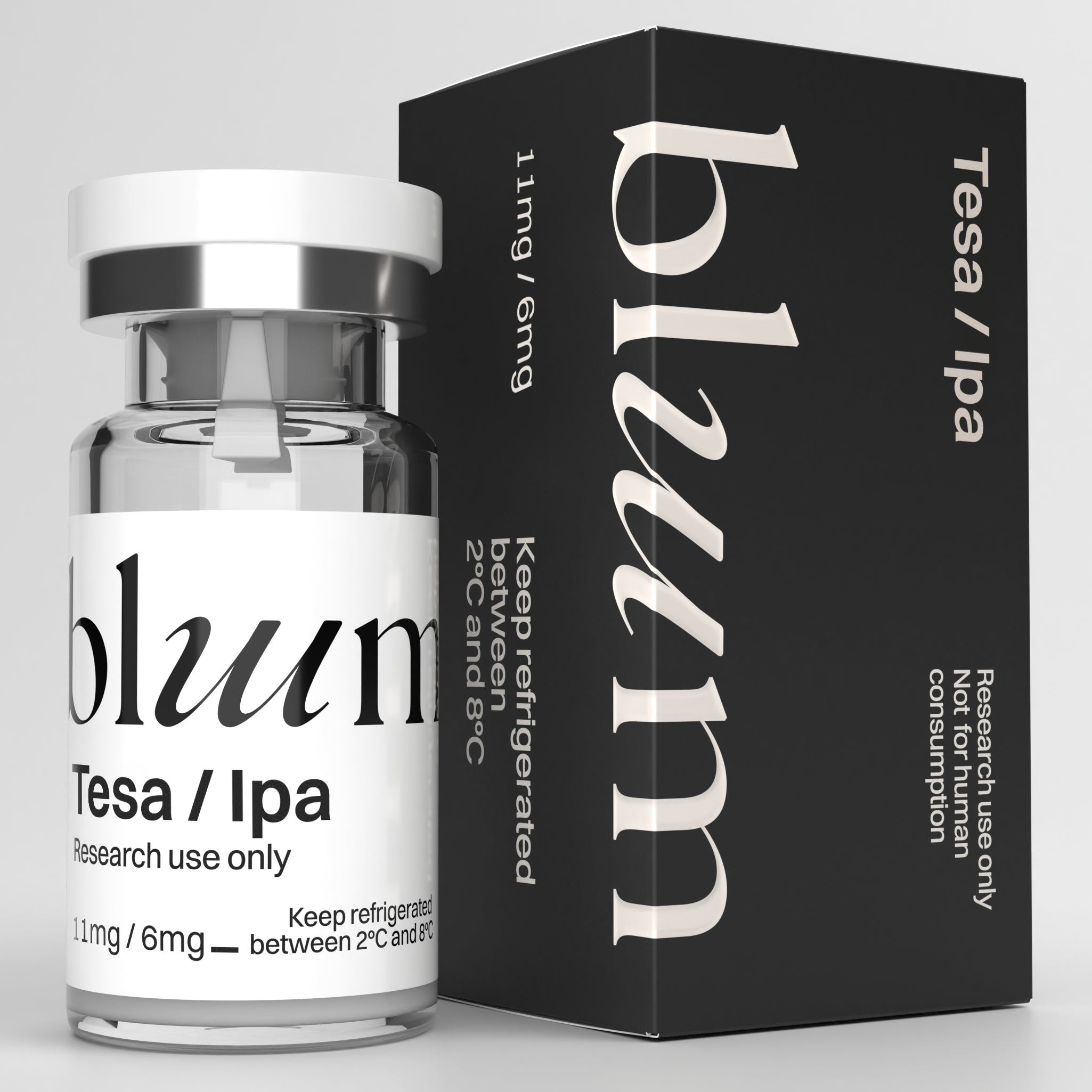







What Is Tesamorelin + Ipamorelin Blend?
Tesamorelin / Ipamorelin Blend is a defined research peptide combination containing two structurally distinct peptides: tesamorelin and ipamorelin. The blend combines a growth hormone-releasing hormone (GHRH) analog with a growth hormone secretagogue, providing a research material for examining two complementary signaling systems associated with regulation of the somatotropic axis.
Tesamorelin is a synthetic peptide analog related to growth hormone-releasing hormone (GHRH). Its research significance centers on its interaction with the GHRH receptor, a class B G protein-coupled receptor expressed on pituitary somatotrophs. Research involving GHRH analogs can be used to investigate receptor activation, intracellular signaling, and regulation of growth hormone secretion.
Similarly, Ipamorelin is a synthetic pentapeptide belonging to the growth hormone secretagogue class. It is associated with the growth hormone secretagogue receptor 1a (GHS-R1a), also known as the ghrelin receptor. Its defined structure provides a research tool for investigating GHS-R1a-mediated signaling and the molecular mechanisms involved in growth hormone secretory regulation.
The combination is scientifically interesting because GHRH and GHS-R1a signaling represent distinct receptor systems that converge on the same somatotroph signaling network. Studying the two components together allows researchers to examine how signals originating from different receptors interact within a shared endocrine signaling pathway.
The blend should not be interpreted as simply combining two equivalent compounds. Tesamorelin and ipamorelin have different molecular structures, receptor targets, and signaling mechanisms. Their inclusion in this defined 10 mg / 2 mg formulation provides a specific experimental material for investigating the relationship between these two signaling systems.
Available research on GHRH and growth hormone secretagogue signaling provides the broader scientific context for studying this combination. However, findings and observations referenced here concerning individual peptides or other GHRH/GHS combinations should not automatically be attributed to this specific Tesamorelin / Ipamorelin Blend as supplied by Bluum Peptides. This Tesamorelin + Ipamorelin Blend is supplied exclusively as a laboratory research material and is not intended for human or veterinary use.
Mechanism of Action (Research Only)
This Tesamorelin / Ipamorelin Blend is scientifically interesting because its two peptide components interact with different receptor systems that converge on the regulation of growth hormone signaling. Tesamorelin is associated with the GHRH receptor, while ipamorelin acts through the growth hormone secretagogue receptor 1a (GHS-R1a). Understanding these pathways separately helps explain why researchers may investigate them together.
Tesamorelin and GHRH Receptor Signaling
Tesamorelin is a synthetic analog of growth hormone-releasing hormone (GHRH), a hypothalamic peptide involved in regulation of growth hormone secretion. GHRH binds to the GHRH receptor (GHRHR), a class B G protein-coupled receptor expressed on pituitary somatotrophs. [1]
GHRH receptor activation primarily couples to the stimulatory G protein Gs. This activates adenylyl cyclase and increases intracellular cyclic adenosine monophosphate (cAMP). Increased cAMP activates protein kinase A (PKA), which can phosphorylate downstream targets involved in transcriptional regulation and secretory activity.
At the level of the somatotroph, this signaling network influences processes associated with growth hormone synthesis and regulated secretion. The pathway therefore provides an experimental system for investigating relationships between peptide–receptor binding, cAMP signaling, intracellular kinase activity, and hormone-associated cellular responses.
Ipamorelin and GHS-R1a Signaling
Ipamorelin belongs to the growth hormone secretagogue class and is associated with the growth hormone secretagogue receptor 1a (GHS-R1a), a G protein-coupled receptor also known as the ghrelin receptor.
GHS-R1a signaling differs from GHRH receptor signaling at the proximal receptor level. Activation of GHS-R1a can engage Gq/11-associated signaling, stimulating phospholipase C and increasing the intracellular second messengers inositol 1,4,5-trisphosphate (IP3) and diacylglycerol (DAG). These pathways influence intracellular calcium dynamics and protein kinase C-associated signaling. [2]
The resulting intracellular changes contribute to the secretory signaling environment of pituitary somatotrophs. Because ipamorelin acts through GHS-R1a rather than the GHRH receptor, it provides researchers with a distinct receptor-mediated input into the same broader growth hormone regulatory system.
Convergence of the Two Signaling Pathways
The scientific significance of combining tesamorelin and ipamorelin lies largely in this receptor-level distinction. GHRH receptor and GHS-R1a signaling originate from different receptors and utilize partially distinct intracellular signaling mechanisms, yet both influence the activity of somatotrophs.
This creates an experimental model for examining how multiple upstream signals converge on a common cellular system. Instead of treating the two peptides as interchangeable growth hormone secretagogues, researchers can use this blend to investigate how GHRH-mediated cAMP signaling and GHS-R1a-associated calcium and phospholipid signaling interact within the same regulatory network.
Investigating GHRH–GHS-R1a Signaling Interactions
Research on the broader growth hormone regulatory system has demonstrated that GHRH and growth hormone secretagogues can interact to produce greater secretory responses than either signaling input alone under certain experimental conditions. The mechanisms underlying this interaction involve convergence between distinct receptor pathways and intracellular signaling systems. [3]
This broader finding provides a scientific rationale for investigating defined combinations of GHRH-related and GHS-R1a-active peptides. However, evidence describing GHRH/GHS interactions generally should not be interpreted as direct evidence that this specific Tesamorelin / Ipamorelin Blend as supplied by Bluum Peptides produces a particular synergistic response.
Research Significance of the Tesamorelin + Ipamorelin Blend
This 10 mg / 2 mg tesamorelin + ipamorelin blend provides researchers with a defined combination of two molecularly distinct signaling inputs. This can be useful when experimental work is designed to examine receptor-level interactions, pathway convergence, signaling relationships, or comparative responses between individual peptide components and a defined combination.
Note that the mechanisms described here represent the established molecular biology of the individual peptide classes and their receptor systems. Experimental observations involving the specific blend remain dependent on the research model, experimental conditions, analytical methods, and study design.
Tesamorelin / Ipamorelin Blend: Research Applications
The Tesamorelin + Ipamorelin combo has useful research applications that can be examined in molecular, cellular, and other laboratory models where researchers are interested in GHRH receptor signaling, GHS-R1a activity, and interactions between these pathways.
GHRH and GHS-R1a Pathway Research
One important research application is investigating how GHRH receptor and GHS-R1a signaling contribute to growth hormone regulatory mechanisms. Because tesamorelin and ipamorelin act through different receptor systems, researchers can examine how these distinct molecular inputs influence a shared signaling network.
Somatotroph Signaling Research
Pituitary somatotrophs provide an important experimental model for studying growth hormone-related signaling. Research can examine how activation of GHRH receptors and GHS-R1a affects intracellular second-messenger systems, cellular signaling events, and regulated secretory processes within these cells.
Receptor and Signaling Pathway Interactions
The blend can be investigated as a defined system for studying interactions between two receptor-mediated signaling pathways. Researchers may examine relationships between GHRH receptor-associated cAMP signaling and GHS-R1a-associated phospholipase C, calcium, and protein kinase C pathways.
Peptide Combination Research
Combining two defined peptides provides an opportunity to compare the molecular and experimental characteristics of individual components with those observed when both signaling inputs are present. Such research can help characterize pathway convergence, response relationships, and potential interactions between distinct peptide signaling systems.
Growth Hormone Axis Research
The broader somatotropic axis provides a model for examining relationships between hypothalamic signaling, pituitary somatotroph activity, growth hormone-associated pathways, and downstream molecular events. Research involving the blend can focus on specific components of this regulatory network without assuming that observations from one experimental model apply universally to others.
Comparative Peptide Research
Tesamorelin / Ipamorelin Blend can also be studied alongside individual GHRH analogs, growth hormone secretagogues, or other defined peptide combinations. Comparative research can examine differences in receptor targets, signaling pathways, molecular structure, and experimental responses between single compounds and defined blends.
Structure–Activity Research
The two components provide structurally distinct peptide systems for investigating relationships between molecular structure and receptor-mediated activity. Researchers can examine how peptide sequence and structural characteristics relate to receptor interactions and downstream signaling, particularly when comparing GHRH-related and GHS-R1a-active compounds.
Research findings involving tesamorelin, ipamorelin, GHRH, or other growth hormone secretagogues should be interpreted according to the specific experimental model and study design. Results from individual compounds or different peptide combinations should not automatically be attributed to the specific Tesamorelin / Ipamorelin Blend supplied by Bluum Peptides.
Tesamorelin / Ipamorelin Blend vs. Tesamorelin vs Ipamorelin vs CJC1295 No DAC + Ipamorelin
Tesamorelin / Ipamorelin Blend belongs to a group of research materials that can be used to investigate growth hormone regulatory signaling through different molecular targets. A comparison with the individual component peptides helps clarify the differences in receptor activity, composition, and research focus.
Characteristic | Tesamorelin / Ipamorelin Blend | |||
Material type | Defined peptide blend | Single peptide | Single peptide | Defined peptide blend |
Components | Tesamorelin + Ipamorelin | Tesamorelin | Ipamorelin | CJC-1295 No DAC + Ipamorelin |
GHRH-related component | Tesamorelin | Tesamorelin | — | CJC-1295 No DAC |
GHS-R1a component | Ipamorelin | — | Ipamorelin | Ipamorelin |
Primary receptor systems | GHRH receptor + GHS-R1a | GHRH receptor | GHS-R1a | GHRH receptor + GHS-R1a |
Research focus | Dual-pathway signaling and pathway convergence | GHRH receptor signaling | GHS-R1a signaling | Dual-pathway signaling |
Useful comparison | Combined signaling model | GHRH pathway reference | GHS-R1a pathway reference | Alternative GHRH/GHS combination |
Note: These compounds are not interchangeable research materials. Differences in peptide sequence, receptor pharmacology, composition, and experimental context can influence research observations. Researchers should select materials according to the specific molecular question and experimental model being investigated.
Tesamorelin / Ipamorelin Blend Comparison with CJC-1295 No DAC / Ipamorelin Blend
These two blends are particularly useful to compare because they share the same basic research concept: two different GHRH-related peptides paired with ipamorelin, allowing researchers to examine GHRH-receptor and GHS-R1a signaling within a defined combination. The main difference is the GHRH-related component, tesamorelin versus CJC-1295 No DAC (Modified GRF 1-29).
This is an important distinction because the two GHRH-related peptides are not structurally identical. Tesamorelin is a longer synthetic GHRH analog, whereas CJC-1295 No DAC represents the shorter GHRH-derived sequence, commonly described as Modified GRF (1-29). Both are associated with GHRH-receptor signaling, but they provide different molecular systems for comparative research.
From a practical research perspective, the choice between the two blends can therefore depend on which GHRH-related peptide the experimental model is designed to investigate. Researchers interested in studying tesamorelin alongside an established GHS-R1a-active peptide can use the Tesamorelin / Ipamorelin Blend, while studies specifically focused on Modified GRF (1-29) can use the CJC-1295 No DAC / Ipamorelin Blend.
Tesamorelin / Ipamorelin Blend Laboratory Handling & Storage
This Tesamorelin / Ipamorelin Blend is supplied as a lyophilized peptide research material and should be handled according to established laboratory practices appropriate for peptide research compounds.
Laboratory handling requirements can vary according to the research environment, experimental model, institutional requirements, and applicable laboratory procedures. Researchers should follow their established standard operating procedures (SOPs) and applicable safety requirements when working with this material.
For general laboratory handling, researchers should consider the following:
Store the unopened vial according to the storage conditions specified on the product label and protect the material from unnecessary exposure to moisture, light, and environmental fluctuations.
Use appropriate personal protective equipment (PPE), including laboratory gloves, eye protection, and protective clothing where required by the laboratory's procedures.
Handle the material in an appropriate laboratory environment and use practices designed to minimize contamination and preserve sample integrity.
Maintain the product lot number, Certificate of Analysis (COA), and other relevant documentation as part of laboratory records and material traceability.
Dispose of unused material and laboratory waste according to institutional procedures and applicable regulations.
Because laboratory requirements and experimental procedures vary, Bluum Peptides does not provide protocol-specific preparation or experimental instructions for this research material.
This Tesamorelin / Ipamorelin Blend by Bluum Peptides is supplied exclusively for laboratory research use only and is not intended for human or veterinary use.
Scientific References
Wang, Y., & Tomlinson, B. (2009). Tesamorelin, a human growth hormone releasing factor analogue. Expert Opinion on Investigational Drugs, 18(3), 303–310.
https://pubmed.ncbi.nlm.nih.gov/19243281/Raun, K., Hansen, B. S., Johansen, N. L., Thøgersen, H., Madsen, K., Ankersen, M., & Andersen, P. H. (1998). Ipamorelin, the first selective growth hormone secretagogue. European Journal of Endocrinology, 139(5), 552–561.
https://pubmed.ncbi.nlm.nih.gov/9849822/Cunha, S. R., & Mayo, K. E. (2002). Ghrelin and growth hormone (GH) secretagogues potentiate growth hormone-releasing hormone (GHRH)-induced cyclic adenosine 3′,5′-monophosphate production in cells expressing transfected GHRH and GH secretagogue receptors. Endocrinology, 143(12), 4570–4582.
https://pubmed.ncbi.nlm.nih.gov/12446584/
Frequently Asked Questions: Tesamorelin / Ipamorelin Blend
What is the Tesamorelin / Ipamorelin Blend?
The Tesamorelin / Ipamorelin Blend as supplied by Bluum Peptides is a defined research material containing 10 mg of tesamorelin and 2 mg of ipamorelin in a single lyophilized powder. The two peptides provide distinct molecular inputs into the somatotropic signaling system: tesamorelin is associated with the GHRH receptor, while ipamorelin acts through GHS-R1a. This makes the blend useful for laboratory research examining the interaction and convergence of these two signaling pathways.
What is the difference between tesamorelin and ipamorelin?
Tesamorelin and ipamorelin belong to different peptide classes and act through different receptor systems. Tesamorelin is a synthetic GHRH analog associated with the GHRH receptor, while ipamorelin is a selective growth hormone secretagogue associated with GHS-R1a, also known as the ghrelin receptor. Researching the two together therefore provides a way to examine distinct receptor-mediated inputs within the same broader signaling system.
Why are tesamorelin and ipamorelin studied together?
The scientific interest comes from the fact that the two peptides engage different but converging signaling pathways. GHRH-receptor signaling and GHS-R1a signaling can influence the same somatotroph cells through different intracellular mechanisms. Research on the broader GHRH/secretagogue system has examined whether simultaneous activation of these pathways produces interactions that differ from activation of either pathway alone. However, findings from this broader research should not be interpreted as direct evidence for the specific blend.
How does the Tesamorelin + Ipamorelin Blend work?
The blend provides two distinct receptor inputs. Tesamorelin activates the GHRH-receptor signaling system, which is primarily associated with Gs, adenylyl cyclase, cAMP, and PKA signaling. Ipamorelin acts through GHS-R1a and can engage Gq/11, phospholipase C, IP3/DAG, and intracellular calcium signaling. Both pathways converge at the level of the somatotroph, giving researchers a defined system for investigating how separate signaling inputs interact within the same cellular network.
What is the difference between Tesamorelin / Ipamorelin and CJC-1295 No DAC / Ipamorelin?
Both are defined two-peptide research blends combining a GHRH-related peptide with ipamorelin, but the GHRH-related component is different. The Tesamorelin / Ipamorelin Blend contains tesamorelin, while the CJC-1295 No DAC / Ipamorelin Blend contains CJC-1295 without DAC, commonly described as Modified GRF (1-29). This makes the two blends useful for comparative research when the objective is to investigate different GHRH-related peptide structures alongside the same GHS-R1a-active component.
What research is the Tesamorelin / Ipamorelin Blend used for?
The blend can be investigated in research involving GHRH and GHS-R1a signaling, somatotroph biology, receptor-pathway interactions, peptide combinations, and the broader somatotropic axis. Researchers can also compare the defined blend with individual peptides or other GHRH/secretagogue combinations to examine differences in molecular signaling and experimental responses. The specific research application and interpretation depend on the experimental model and study design.
Is the Tesamorelin / Ipamorelin Blend third-party tested?
Yes. Bluum Peptides is committed to ensuring that every product batch is independently tested by third-party labs, including Janoshik, BioRegen, and others. The current Tesamorelin / Ipamorelin Blend batch at the time of writing was tested by Freedom Diagnostics, with a reported 99.67% purity by HPLC-UV and mass-spectrometric identity analysis. Researchers should always review the COA associated with the specific lot they receive because analytical results are batch-specific.
What purity does Bluum's Tesamorelin / Ipamorelin Blend have, and can I see the COA?
The current batch is reported at 99.67% purity by HPLC-UV. Its analytical documentation also includes mass-spectrometric identity analysis and an endotoxin result. Bluum Peptides makes batch documentation available so researchers can review the analytical record associated with their material. The lot number on the product or order documentation can also be used to locate available reports through Bluum's COA Lookup system.