

AOD-9604 (AOD9604, Tyr-hGH 177-191; CAS 221231-10-3) is a synthetic 16-amino-acid C-terminal peptide fragment of human growth hormone (molecular formula C78H123N23O23S2, molecular weight 1,815.12 g/mol) containing a single intramolecular disulfide bridge for in-vitro lipid-metabolism research. Bluum Peptides stocks 5 mg vials ($39), with current lot AOD52609-144I tested at 99.87% HPLC purity (6.06 mg measured, LC-MS identity confirmed) by Freedom Diagnostics in the lab report library.
Researchers designed AOD-9604 to isolate the C-terminal 177-191 region of the 191-amino-acid human growth hormone molecule while separating it from canonical growth hormone receptor signaling and IGF-1 induction pathways. In laboratory work, verifying disulfide-bridge closure and preventing aggregation are the central analytical challenges.
Before selecting an AOD-9604 lot, labs audit four data points: LC-MS confirmation at 1,815.12 g/mol (confirming the oxidized cyclic disulfide rather than reduced linear peptide), RP-HPLC purity, measured mg content, and LAL endotoxin clearance.
What is AOD-9604 peptide?
AOD-9604 (also cataloged as AOD 9604 and AOD9604; PubChem CID 71300630) is a modified synthetic peptide fragment corresponding to residues 177-191 of the human growth hormone molecule with an added N-terminal tyrosine residue. Its 16-amino-acid sequence is Tyr-Leu-Arg-Ile-Val-Gln-Cys-Arg-Ser-Val-Glu-Gly-Ser-Cys-Gly-Phe, linked by an intramolecular disulfide bridge between Cys7 and Cys14.
Adding the N-terminal tyrosine stabilizes the fragment relative to the unmodified hGH 177-191 sequence and aids UV detection during reversed-phase chromatography. Unlike full-length recombinant human growth hormone (191 amino acids, ~22.1 kDa), AOD-9604 is built entirely via solid-phase peptide synthesis (SPPS) followed by controlled disulfide oxidation and preparative RP-HPLC purification.
Search chemical registries and vendor COA portals under all three label formats (AOD-9604, AOD 9604, and AOD9604) to keep analytical records and reference literature aligned.
What fat metabolism and lipid-signaling research investigates AOD 9604?
Preclinical and cell-culture studies investigate this research peptide primarily in adipocyte fat metabolism models, lipolytic signaling assays, and comparative studies of in-vitro metabolic effects against intact human growth hormone. Investigators examine whether isolating the C-terminal region of human growth hormone alters adipose tissue signaling readouts without engaging classical growth hormone receptor activation or shifting circulating IGF-1 levels in preclinical models.
A secondary body of preclinical literature evaluates AOD-9604 alongside glucose metabolism markers and chondrocyte or cartilage-matrix cell models. Published findings across cell lines and animal models vary with experimental conditions, and historical clinical trials investigating metabolic endpoints did not result in regulatory approval.
Because AOD-9604 lacks a single universally accepted receptor target in the literature, researchers treat published pathway observations as exploratory and design experiments with strict vehicle and comparator controls.
How does AOD-9604 compare with Tesamorelin and intact growth hormone?
AOD-9604 and Tesamorelin are frequently grouped in catalog lists, yet they act on completely distinct biological layers. AOD-9604 is a 16-residue C-terminal growth hormone fragment, whereas Tesamorelin is a 44-residue synthetic growth hormone-releasing hormone (GHRH) analogue that targets pituitary GHRH receptors.
AOD-9604 (Tyr-hGH 177-191)
Verdict: Disulfide-bridged 16-residue C-terminal fragment of human growth hormone (CAS 221231-10-3, 1,815.12 g/mol) studied in adipocyte lipid-metabolism models without direct GHRH-receptor stimulation.
- Best for: In-vitro adipocyte signaling, lipolytic pathway assays, and comparative hGH-fragment structure-activity studies.
- Analytical risk: Disulfide cyclization must be verified by MS (reduced linear form is +2.02 Da heavier), and hydrophobic residues increase aggregation risk in aqueous buffers.
- Bluum pricing: 5 mg vial at $39 ($37.05 for 5+, $35.10 for 10+) on the AOD9604 product page.
Tesamorelin
Verdict: 44-residue N-terminally trans-3-hexenoyl-modified GHRH analogue (CAS 218949-48-5, 5,135.9 g/mol) studied in pituitary GHRH-receptor activation and GH/IGF-1 axis signaling models.
- Best for: GHRH receptor binding, somatotroph signaling kinetics, and upstream growth hormone-axis assays.
- Analytical risk: 44-residue chain complexity increases SPPS deletion-sequence risk and demands rigorous LC-MS mass confirmation.
- Bluum pricing: 5 mg ($39), 10 mg ($69), and 20 mg ($119) vials on the Tesamorelin product page.
| Attribute | AOD-9604 | Tesamorelin | Full-Length hGH (1-191) |
|---|---|---|---|
| CAS number | 221231-10-3 | 218949-48-5 | 12629-01-5 |
| Chain length | 16 amino acids | 44 amino acids | 191 amino acids |
| Molecular weight | 1,815.12 g/mol | 5,135.9 g/mol | ~22,124 g/mol |
| Structural motif | Single Cys7-Cys14 disulfide loop | Linear, trans-3-hexenoyl cap | Four-helix bundle, 2 disulfides |
| Primary signaling layer | Adipocyte lipid-metabolism models (non-GHRH) | Pituitary GHRH receptor agonist | Canonical growth hormone receptor |
| IGF-1 axis engagement | Reported absent in preclinical models | Upstream GH/IGF-1 pathway | Direct IGF-1 transcriptional driver |
Why does disulfide-bond chemistry matter on an AOD-9604 COA?
AOD-9604 contains two cysteine residues (Cys7 and Cys14) that must oxidize intramolecularly to form a closed cyclic loop. If synthesis oxidation is incomplete, the batch retains reduced free-thiol linear peptide (+2.02 Da mass shift); if oxidation runs at excessive concentration, intermolecular disulfide dimers (~3,630 Da) or oligomers form.
Because linear precursors and dimers can co-elute near the parent peak under shallow gradients, a defensible AOD-9604 COA pairs an RP-HPLC chromatogram with LC-MS confirmation matching the oxidized 1,815.12 g/mol mass. Reviewing historical and current Bluum Peptides 5 mg AOD-9604 lots illustrates realistic batch variation:
| Format and lot | Independent lab | Report # and date | HPLC purity | Measured content | Identity and panels |
|---|---|---|---|---|---|
| 5 mg (AOD52609-144I, current) | Freedom Diagnostics | 2609170914 (2026-09-19) | 99.87% | 6.06 mg | LC-MS identity confirmed; LAL endotoxin |
| 5 mg (AOD52605-82A, archived) | Freedom Diagnostics | 2605210218 (2026-05-23) | 98.73% | Not listed on summary | COA, LAL endotoxin |
| 5 mg (513210, archived) | Third-party lab (archived) | 12643 (2026-03-30) | 99.13% | Not listed on summary | COA, LAL endotoxin |
Current 5 mg lot AOD52609-144I measured 99.87% HPLC purity with 6.06 mg net content and LC-MS confirmation by Freedom Diagnostics, up from 98.73% on archived May lot AOD52605-82A. Checking the measured fill weight (6.06 mg rather than a nominal 5.00 mg assumption) prevents a 21% concentration error in quantitative cell-culture setups.
Why do chromatographic purity and net peptide content differ?
RP-HPLC purity quantifies the percentage of UV-absorbing peptide peaks belonging to AOD-9604, while net peptide content quantifies what share of the vial's gross powder mass is actual peptide rather than residual moisture and counterion salts (acetate or trifluoroacetate). AOD-9604 contains two basic arginine residues alongside acidic glutamate, so salt stoichiometry varies across purification runs.
Always calculate molar concentrations from the COA's measured mg content rather than nominal vial weight, and verify whether your assay requires acetate-exchanged stock if cells exhibit sensitivity to trifluoroacetate.
Why is AOD-9604 supplied lyophilized, and how should labs store it?
AOD-9604 contains hydrophobic stretches (Leu-Arg-Ile-Val and Phe) paired with a disulfide loop that makes aqueous solutions prone to gelation, precipitation, or disulfide scrambling over time. Supplying AOD-9604 as a solid white lyophilized powder in a sealed 3 mL vial preserves monomeric integrity during shipping and storage.
Follow the storage guidance printed on the vial label: Bluum's product specification lists sealed dry storage at <=6 degrees C away from heat, light, and moisture (and -20 degrees C is standard for long-term archival stock). Equilibrate sealed cold vials to room temperature before opening. Evaluate buffer pH, ionic strength, aggregation behavior, and solution stability strictly under your laboratory's validated institutional protocols.
What in-vitro study design controls apply to AOD-9604 assays?
Because hydrophobic disulfide peptides can self-associate at neutral pH, confirm optical clarity and verify that solutions remain free of visible particulates or aggregates before exposing cell monolayers. Include solvent-matched vehicle controls, multi-point concentration curves, and a defined positive control for the measured lipid-metabolism endpoint.
Verify lot-matched LAL endotoxin clearance before using AOD-9604 in primary adipocyte or stromal vascular cultures, where trace bacterial endotoxin alters lipolytic and inflammatory gene expression independently of the peptide. Log the lot code and COA report ID in your lab notebook.
How should laboratories evaluate an AOD-9604 research peptide supplier?
Require a batch-specific third-party COA matching the exact lot code on the 5 mg vial before purchase. Confirm four analytical checks: RP-HPLC chromatogram and purity percentage, LC-MS identity matching oxidized cyclic AOD-9604 at 1,815.12 g/mol, measured mg content, and LAL endotoxin testing.
Validate accession numbers directly on the issuing lab's verification portal (such as FreedomDiagnosticsTesting.com). Bluum Peptides publishes active and archived AOD-9604 documentation on the AOD9604 product page and in the lab report library, with same-business-day U.S. shipping on in-stock orders placed before 1 p.m. CT.
Frequently asked questions
What is AOD-9604 peptide?
AOD-9604 (CAS 221231-10-3, 1,815.12 g/mol) is a synthetic 16-amino-acid C-terminal fragment of human growth hormone (Tyr-hGH 177-191) stabilized by a Cys7-Cys14 disulfide bridge. Laboratories use it as a lyophilized research reagent in adipocyte lipid-metabolism studies.
How does AOD-9604 differ from full-length human growth hormone?
Full-length human growth hormone is a 191-amino-acid protein (~22.1 kDa) that activates the canonical growth hormone receptor and drives IGF-1 signaling. AOD-9604 isolates only the final 15 residues plus an N-terminal tyrosine (16 AA total) to study lipolytic pathways separately from canonical GH receptor signaling.
Why is LC-MS identity important for AOD-9604 batches?
AOD-9604 requires an intact intramolecular disulfide bridge between Cys7 and Cys14. LC-MS verifies the oxidized 1,815.12 g/mol mass and rules out uncyclized reduced precursor (+2.02 Da) or disulfide dimers.
How should lyophilized AOD-9604 be stored?
Store sealed dry vials protected from heat, light, and moisture per the batch label (<=6 degrees C per product specification, or -20 degrees C for archival reference stock). Allow cold vials to reach room temperature before unsealing.
Is AOD-9604 approved as a drug or for non-laboratory applications?
No. AOD-9604 is not an approved drug and is sold by Bluum Peptides strictly for controlled laboratory research use. It is not formulated, manufactured, or documented for clinical, dietary, or veterinary administration.
Disclaimer: All compounds discussed here, including any referenced products, are sold strictly for controlled laboratory research use only. They are not for clinical, diagnostic, or veterinary applications, and nothing here provides instructions outside a controlled research setting.
Compounds referenced in this article
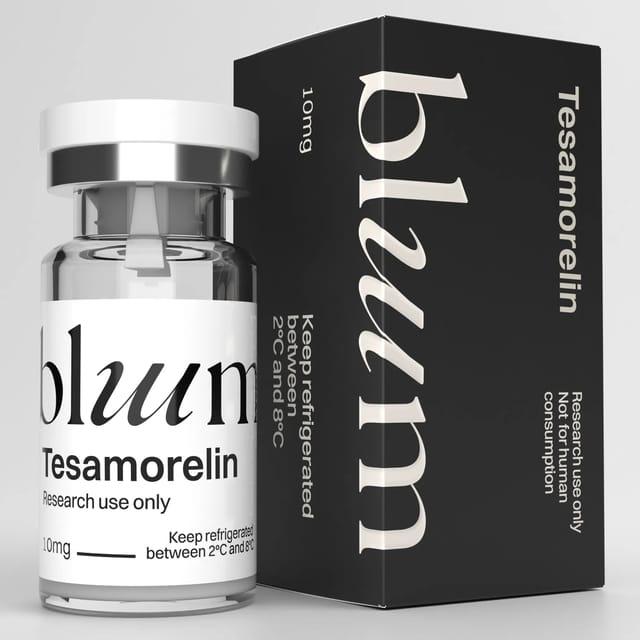
Tesamorelin
From $69.00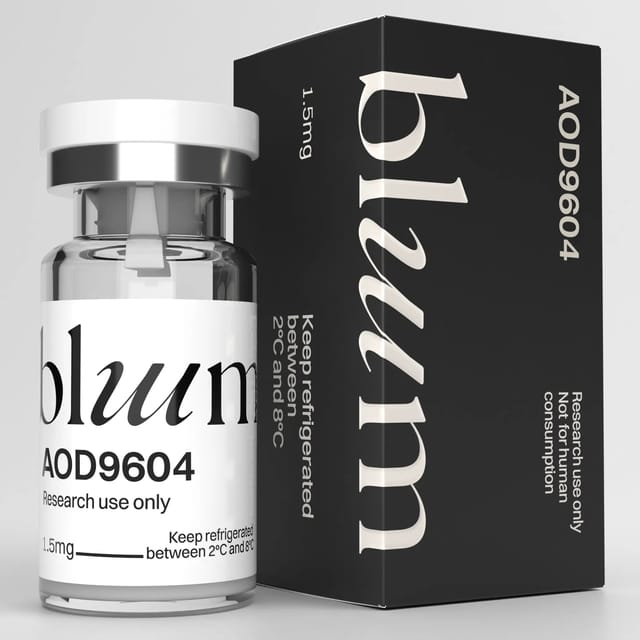
AOD9604
$39.00

Bluum Peptides supplies these compounds for laboratory research. Every lot is tested by an independent lab before it ships, and each lab report can be looked up by lot number in the COA library. For research use only; not for human or veterinary use.


