

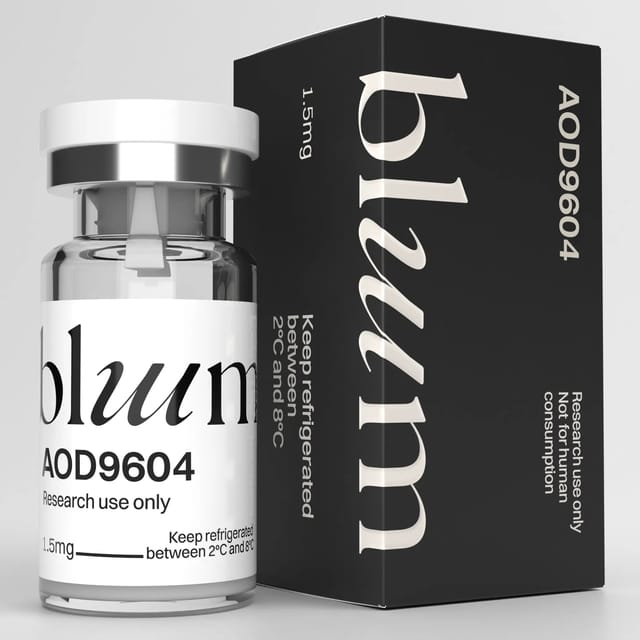
AOD9604
 Money Back
Guarantee
 Satisfaction
Guarantee
 Easy Returns
 Secure
Ordering
 2-Day
Shipping
 Third Party
Tested
 Batch & Lot
Tracking
Lab results
RESEARCH USE ONLY
These compounds are NOT intended for human consumption, clinical use, or veterinary applications. We are not affiliated with any pharmaceutical companies or their commercial medications. By placing an order, you certify these materials will be used exclusively for in vitro testing and laboratory experimentation only. Bodily introduction of any kind into humans or animals is strictly forbidden by law. This product should only be handled by licensed, qualified professionals. This product is not a drug, food, or cosmetic and may not be misbranded, misused or mislabeled as a drug, food or cosmetic.
About AOD9604
AOD9604 is a synthetic peptide based on a modified fragment of human growth hormone, designed with a cysteine-containing sequence and intramolecular disulfide bridge that influences its molecular conformation. It has been investigated in laboratory and experimental research examining lipid metabolism, adipose biology, and related metabolic pathways. AOD9604 gives researchers a defined peptide model for studying biological activity associated with this region of the growth hormone molecule.
Bluum Peptides supplies high-purity, research-grade AOD9604 in a 5 mg vial with verified purity of 99.13%. These purity results are supported by a Certificate of Analysis (COA) and an endotoxin report, giving researchers documented analytical information for every product batch. Sold for research use only.
Available Sizes
AOD9604 is supplied as a high-purity lyophilized powder in vial sizes selected to support a range of research applications and experimental conditions.
- AOD9604 5 mg vial
AOD9604 Product Specifications
| Product Specifications | AOD-9604 Lyophilized Powder in 3ml vial. |
|---|---|
| Application | Growth hormone fragment that mimics the lipolytic (fat-reducing) domain of human growth hormone |
| Appearance | Solid, white powder in 3mL vial |
| Chemical Formula | C78H123N23O23S2 |
| PubChem CID | 71300630 |
| CAS Number | 221231-10-3 |
| Molecular Weight | 1815.12 g/mol |
| Synonyms | AOD 9604, AOD-9604, AOD9604, somatostatin (177-191), Tyr-, somatostatin (177-191), tyrosyl-, Tyr-somatostatin (177-191) |
| Storage | Store at ≤6°C, sealed, away from heat, light and moisture. |
| Chemical grade | Laboratory |
Chemical Structure
Mechanism of Action (Research Only)
AOD9604 is a synthetic peptide derived from the C-terminal region of human growth hormone (hGH). Although its sequence originates from hGH, AOD9604 does more than reproduce the signaling profile of the intact hormone. Research suggests that AOD-9604 is focused on biological activity associated with the C-terminal region, particularly its relationship to pathways regulating lipid metabolism and adipose-tissue biology.
The precise molecular target of AOD9604 has not been definitively established. However, available experimental evidence suggests that its activity involves mechanisms distinct from classical growth hormone receptor signaling, making the peptide particularly relevant to research examining how specific structural regions of hGH can produce biological effects independently of the complete hormone.
C-Terminal Growth Hormone Region
The C-terminal region of hGH has long been investigated as a distinct functional region of the molecule. AOD9604 was developed from this region as a shorter, defined peptide sequence, allowing researchers to study its biological properties without the remainder of the growth hormone structure.
This distinction is mechanistically important because full-length hGH binds the growth hormone receptor and initiates signaling through pathways including JAK2/STAT5 and related downstream signaling networks. Although AOD9604 is a shorter sequence originating from hGH, experimental research suggests it has biological effects associated with lipid metabolism that are separable from the classical endocrine actions of intact growth hormone. [1]
Lipolytic Signaling
A major mechanistic area investigated with AOD9604 is lipolysis, which is the enzymatic breakdown of stored triglycerides within adipocytes. Early experimental studies examined the peptide in adipose-tissue models and reported increased lipolytic activity following exposure to AOD9604. These observations provided a basis for investigating whether the C-terminal region of hGH contains structural features capable of influencing adipocyte lipid metabolism independently of the full hormone. [2]
At the cellular level, lipolysis involves coordinated regulation of enzymes and signaling proteins that control access to stored triglycerides. AOD9604 research has therefore focused on whether exposure to the peptide alters the regulation of these processes rather than simply measuring changes in total lipid content.
However, the precise molecular event through which AOD9604 initiates these responses remains unresolved. The available evidence supports an association with altered lipolytic activity, but it does not establish a single receptor-mediated mechanism responsible for these observed effects.
β3-Adrenergic Receptor Pathway
The β3-adrenergic receptor (β3-AR) has been investigated as a potential component of AOD9604-associated signaling because of its established role in the metabolism of adipose tissue and regulation of lipolytic responses.
Experimental work found that AOD9604 exposure was associated with changes in β3-AR expression and altered lipolytic sensitivity in adipose tissue. However, studies using β3-AR knockout models provided an important mechanistic qualification: the observed biological response did not depend on direct activation of β3-AR itself. [1]
This suggests that β3-adrenergic signaling may be involved indirectly, potentially through changes in receptor expression or cellular sensitivity, rather than AOD9604 functioning as a conventional β3-adrenergic agonist. Consequently, β3-AR is better described as a pathway investigated in connection with AOD9604 activity instead of an established direct molecular target.
Structural Contribution
AOD9604 contains two cysteine residues connected by an intramolecular disulfide bond. This bond constrains part of the peptide into a defined structural arrangement rather than leaving the sequence entirely flexible. [3]
For peptide research, this structural constraint is relevant because biological interactions depend not only on amino-acid sequence but also on the three-dimensional conformation presented by that sequence. The disulfide-linked structure can therefore be considered when investigating relationships between AOD9604's molecular architecture and its experimentally observed activity.
The presence of the disulfide bond should not, however, be interpreted as proof of a particular biological mechanism. Its precise contribution to AOD9604 activity requires direct structure-function investigation.
Current evidence supports investigating AOD9604 as a distinct peptide model associated with lipid-metabolism signaling rather than treating it as a miniature version of full-length growth hormone. Research has identified effects on lipolytic processes and investigated relationships with β3-adrenergic signaling, while the precise receptor or molecular initiating event remains unresolved.
This makes AOD9604 particularly relevant to mechanistic studies examining how a defined peptide sequence derived from a larger signaling protein can exhibit distinct biological behavior. Findings should be interpreted according to the specific experimental system and should not be extended beyond the evidence provided by the relevant research model.
Purity and Quality Assurance
Bluum Peptides supplies AOD9604 as a research-grade material with documented purity and quality for every batch. The current listed lot has a 99.13% verified purity, supported by a Certificate of Analysis and endotoxin documentation. Bluum Peptides also provides a 99% minimum purity guarantee across its research products, a solid commitment to consistent, analytically proven research materials.
Research Applications (Observations from Studies)
AOD9604 has been investigated across several experimental settings, with research concentrating primarily on lipid metabolism, adipose-tissue biology, and the biological activity of growth hormone-derived peptide sequences. Additional preclinical research has examined the peptide in cartilage and joint-tissue models. The following areas represent subjects investigated in published laboratory and preclinical studies.
Lipid Metabolism and Lipolysis Research
One of the earliest areas of AOD9604 research involved lipid metabolism and the regulation of lipolysis in adipose tissue. Researchers investigated the peptide as a synthetic analogue of a lipolytic region of human growth hormone, using animal and ex vivo experimental models to examine changes in adipose-tissue metabolism. [2]
In a study published in Hormone Research, Ng and colleagues investigated AOD9604 in obese Zucker rats and observed increased lipolytic activity in adipose tissue following experimental exposure. The study provided early evidence for investigating the peptide's relationship with lipid mobilization and established adipose-tissue metabolism as a major area of AOD9604 research.
Subsequent work examined the relationship between AOD9604 and adrenergic signaling in obese mice. Researchers observed changes in β3-adrenergic receptor RNA expression and investigated whether these changes could contribute to altered lipolytic sensitivity.
Experiments involving β3-adrenergic receptor knockout mice helped distinguish between direct receptor activation and indirect effects on the pathway.
Adipose-Tissue Biology
AOD9604 has also been studied as an experimental tool for investigating how defined peptide sequences derived from growth hormone interact with adipose-tissue biology. [2]
Research models have examined processes including lipid storage and mobilization, lipolytic sensitivity, and changes in adipose-tissue metabolic activity. These studies are useful for investigating the relationship between peptide structure and metabolic signaling while separating the activity of the C-terminal growth hormone region from the broader biological actions of the intact hormone.
Animal studies have also been used to examine changes in body composition and energy-related metabolic parameters following experimental exposure to AOD9604. Because these findings originate predominantly from controlled animal models, they provide mechanistic and preclinical observations rather than evidence of an established application in humans.
Metabolic and Pharmacological Research
Research into AOD9604 has also examined how the peptide behaves within experimental systems and whether its metabolic activity observed in animal models can be characterized through controlled pharmacological studies. Investigators have evaluated parameters such as peptide exposure, biological response, and changes in metabolic measures to better understand the relationship between AOD9604 concentration and observed effects.
This work complements studies of AOD9604's mechanism by providing information about the compound's pharmacological characteristics in experimental models. Together, these studies have helped researchers characterize AOD9604 as a defined growth hormone-derived peptide and investigate how its molecular structure relates to its observed biological activity.
Cartilage and Joint-Tissue Research
A separate area of preclinical research has examined AOD9604 in models of cartilage biology and experimentally induced joint degeneration.
In a rabbit model of collagenase-induced osteoarthritis, researchers investigated AOD9604 administered alone and in combination with hyaluronic acid. The study evaluated cartilage morphology and histopathological changes, providing experimental data on the peptide's effects within a joint-tissue research model. The investigators reported differences in cartilage-related outcomes between experimental groups, with the combination treatment producing the strongest effects in that particular model. [4]
This work represents a distinct research direction from AOD9604's more extensively studied relationship with lipid metabolism. It may be relevant to researchers investigating growth hormone-derived peptide sequences in cartilage and extracellular-matrix biology, although findings from an experimental rabbit model should not be extrapolated to human therapeutic applications.
Structure–Activity Research
Because AOD9604 is a defined fragment derived from human growth hormone, it can also serve as an experimental model for studying relationships between peptide sequence, molecular structure, and observed biological activity.
Its relatively short sequence and intramolecular disulfide bond provide researchers with identifiable structural features that can be considered when comparing peptide variants or investigating how changes in peptide architecture influence experimental behavior. Such structure–activity studies can help distinguish properties associated with a specific peptide sequence from those requiring the complete growth hormone molecule.
Overall, published research on AOD9604 spans metabolic, adipose-tissue, pharmacological, and cartilage-related experimental models. The evidence varies substantially by research area, with the strongest historical concentration around lipid metabolism and adipose biology. Results should therefore be interpreted according to the specific experimental system in which they were obtained.
AOD9604 vs hGH Fragment 176–191 vs Tesamorelin Comparison
AOD9604 belongs to a broader group of growth hormone-related research peptides investigated in metabolic and adipose-tissue research. However, these compounds can differ substantially in sequence, structure, molecular target, and signaling mechanism. Comparing AOD9604 with hGH Fragment 176–191 and tesamorelin helps distinguish compounds that share overlapping research areas but operate at different points within growth hormone-related biology.
Characteristic | AOD9604 | hGH Fragment 176–191 | |
Peptide class | Synthetic hGH-derived peptide | hGH-derived peptide fragment | Synthetic GHRH analogue |
Relationship to hGH | Derived from the C-terminal region | Corresponds to a C-terminal hGH sequence | Acts upstream of hGH as a GHRH-related compound |
Primary research context | Lipid metabolism and adipose biology | hGH C-terminal fragment and lipid-metabolism research | Growth hormone-axis and metabolic research |
Sequence | YLRIVQCRSVEGSCGF | hGH-derived 176–191 sequence | GHRH analogue |
Length | 16 amino acids | 16 amino acids | 44 amino acids |
Intramolecular disulfide bond | Yes | Related cysteine-containing structure | No comparable intramolecular disulfide feature |
Primary signaling focus | Lipolytic and adipose-tissue pathways under investigation | C-terminal hGH-derived biological activity | GHRH receptor signaling and downstream GH-related pathways |
Research models | Cellular, adipose-tissue, and animal models | Experimental models of hGH-derived peptide biology | Cellular and animal models of GHRH/GH-axis biology |
Mechanistic status | Molecular target remains incompletely defined | Investigated as a C-terminal hGH-derived sequence | GHRH receptor-mediated signaling is established as the principal pathway |
Best suited for comparative research involving | C-terminal hGH peptide structure and lipid metabolism | hGH fragment sequence and structure–activity relationships | GHRH signaling and growth hormone-axis regulation |
These three peptides illustrate different approaches to investigating growth hormone-related biology. AOD9604 and hGH Fragment 176–191 are structurally related and are particularly useful when the research question concerns the C-terminal region of hGH and its relationship to lipid metabolism. Tesamorelin provides a mechanistically different comparison by representing a GHRH-derived approach that operates through the upstream regulatory system of growth hormone secretion.
Consequently, these compounds should not be considered interchangeable research materials. Their different sequences, structures, targets, and signaling mechanisms make each appropriate for different experimental questions. When selecting a research compound, researchers should evaluate the precise molecular identity and the biological pathway relevant to the study rather than relying solely on overlapping application terminology.
AOD9604 Laboratory Handling & Storage
AOD9604 is supplied as a lyophilized research-grade peptide and should be handled according to established laboratory practices appropriate for synthetic peptide research materials.
Laboratory handling procedures may vary according to institutional requirements, research protocols, and study objectives. Researchers should follow applicable laboratory standard operating procedures (SOPs), chemical hygiene requirements, and institutional safety guidelines when working with AOD9604.
For general laboratory handling, researchers should consider the following practices:
Store unopened material according to the storage conditions specified by the product documentation and protect the vial from unnecessary exposure to light, moisture, and environmental conditions that could affect sample integrity.
Handle the material using appropriate personal protective equipment (PPE), such as laboratory gloves, eye protection, and protective clothing where required by the laboratory's procedures.
Use appropriate laboratory controls to minimize contamination and maintain the integrity and traceability of the research material.
Keep the original product identification, lot information, Certificate of Analysis (COA), and other supporting documentation with laboratory records.
Avoid unnecessary environmental exposure when handling or storing the peptide, particularly repeated or prolonged exposure to conditions that may affect the integrity of a lyophilized research material.
Dispose of unused material, contaminated consumables, and laboratory waste according to institutional procedures and applicable regulations.
Because laboratory requirements and experimental procedures vary, Bluum Peptides does not provide protocol-specific preparation, experimental, or application instructions for AOD9604. The product is supplied exclusively for qualified laboratory research and is not intended for human or veterinary use.
Certificate of Analysis (COA) & Quality Assurance
At Bluum Peptides, documented quality assurance is an important part of supplying research-grade compounds for laboratory research. AOD9604 is supplied with batch-specific quality documentation to support material identification, quality control, and laboratory recordkeeping.
The current AOD9604 lot is reported at 99.13% purity and is supported by a Certificate of Analysis (COA) and an endotoxin report. The product documentation identifies the specific lot as AOD52605, allowing the analytical results to be associated with the material supplied.
Batch documentation can provide researchers with important information for maintaining traceability and supporting consistent laboratory records. Depending on the applicable documentation, this may include:
Lot or batch identification
Reported purity and analytical results
Product identity and testing information
Testing dates and laboratory information
Supporting quality-control documentation
Endotoxin testing information where provided
Bluum Peptides also maintains a 99% minimum purity guarantee across our research products. The company works with independent analytical laboratories for third-party quality verification, with a testing network of accredited labs including Janoshik Analytical, BioRegen, and Freedom Diagnostics.
AOD9604 is supplied exclusively as a laboratory research material and is not intended for human or veterinary use.
Frequently Asked Questions About AOD9604
What is AOD9604?
AOD9604 is a synthetic peptide derived from the C-terminal region of human growth hormone. It is studied as a defined research compound in experimental investigations involving lipid metabolism, adipose-tissue biology, and related metabolic pathways. AOD9604 contains 16 amino acids and an intramolecular disulfide bond between its cysteine residues.
What is AOD9604 studied for?
Research involving AOD9604 has primarily examined lipid metabolism, lipolysis, and adipose-tissue biology in experimental models. Additional preclinical research has investigated the peptide in cartilage and joint-tissue models, as well as its pharmacological characteristics and structure–activity relationships.
How does AOD9604 work?
The complete molecular mechanism of AOD9604 has not been definitively established. Experimental research has associated the peptide with changes in lipolytic activity and has investigated its relationship with β3-adrenergic signaling in adipose tissue. Studies suggest that β3-adrenergic signaling may be involved indirectly rather than through direct activation of the β3-adrenergic receptor.
What is the sequence of AOD9604?
AOD9604 is a 16-amino-acid synthetic peptide with the sequence YLRIVQCRSVEGSCGF. The peptide contains two cysteine residues that form an intramolecular disulfide bond. Sequence-level identification is important when distinguishing AOD9604 from other growth hormone-derived peptide fragments.
Is AOD9604 the same as hGH Fragment 176–191?
AOD9604 and hGH Fragment 176–191 are closely related growth hormone-derived research peptides, but their molecular definitions should not be assumed to be identical. AOD9604 is characterized by its specific sequence and intramolecular disulfide structure. Researchers comparing the compounds should use verified sequence, molecular weight, and analytical characterization rather than relying solely on product names.
What is the molecular weight of AOD9604?
The molecular weight listed for AOD9604 is approximately 1,815.1 g/mol. Molecular weight is an important specification for analytical characterization and can be used alongside techniques such as mass spectrometry to support molecular identity.
What purity does Bluum Peptides AOD9604 have?
Bluum Peptides' current listed AOD9604 lot, AOD52605-82A, has a reported purity of 98.73%. This purity is supported by a Certificate of Analysis (COA) and an endotoxin report. Bluum Peptides maintains a 99% minimum purity guarantee across its research products, providing a defined quality benchmark for its research-grade materials.
Does Bluum Peptides provide a COA for AOD9604?
Yes. Bluum Peptides provides batch-specific quality documentation for AOD9604, including a Certificate of Analysis and supporting endotoxin documentation for the current listed lot. The lot-specific documentation allows researchers to associate analytical results with the particular material supplied and retain the information as part of laboratory quality-control and research records.
Scientific References
Heffernan, M., Summers, R. J., Thorburn, A., Ogru, E., Gianello, R., Jiang, W. J., & Ng, F. M. (2001). The effects of human GH and its lipolytic fragment (AOD9604) on lipid metabolism following chronic treatment in obese mice and beta(3)-AR knock-out mice. Endocrinology, 142(12), 5182–5189.
https://pubmed.ncbi.nlm.nih.gov/11713213/Ng, F. M., Sun, J., Sharma, L., Libinaka, R., Jiang, W. J., & Gianello, R. (2000). Metabolic studies of a synthetic lipolytic domain (AOD9604) of human growth hormone. Hormone Research, 53(6), 274–278.
https://pubmed.ncbi.nlm.nih.gov/11146367/Cox, H. D., Smeal, S. J., Hughes, C. M., Cox, J. E., & Eichner, D. (2015). Detection and in vitro metabolism of AOD9604. Drug Testing and Analysis, 7(1), 31–38.
https://pubmed.ncbi.nlm.nih.gov/25208511/Kwon, D. R., & Park, G. Y. (2015). Effect of intra-articular injection of AOD9604 with or without hyaluronic acid in rabbit osteoarthritis model. Annals of Clinical & Laboratory Science, 45(4), 426–432.
https://pubmed.ncbi.nlm.nih.gov/26275694/
Related Peptides
Shop All PeptidesYou ask,
we answer.
Are these peptides quality tested?
Absolutely. Our analytical testing is conducted by Janoshik Analytical, BioRegen, or Freedom Diagnostics, independent third-party laboratories that verify the identity, purity, and composition of our research products. All products are guaranteed to test at 98% purity or higher. Each CoA includes purity analysis, peptide sequence confirmation, date of analysis, and an endotoxin report.
What are typical delivery times?
Free 2-Day Air shipping is available when qualifying merchandise totals reach $200. Overnight Air is also available. Please allow up to 24 hours for processing.
Every package comes with professional packaging and tracking updates via email.
How should these compounds be stored?
Our peptides are shipped in lyophilized form, which is stable at room temperature during transit. Once received, store unopened vials in a cool, dry place.
Are products stable during shipping?
Our peptides are shipped in lyophilized (freeze-dried) form, which ensures stability during transit. This powder form is highly stable at room temperature and resistant to temperature fluctuations that occur during shipping.
Research has shown no significant degradation or loss of purity when lyophilized peptides are exposed to room temperature during typical shipping timeframes. Each batch is verified for purity upon production, and our stability testing confirms maintenance of product integrity during standard shipping conditions.
What are your bulk ordering options?
For bulk inquiries and volume pricing, please contact us.
What is the shelf life/expiration of unopened vials?
Each lot lists a best-by/expiration on the vial label and COA. As general guidance, lyophilized peptides stored as directed are typically stable 12–24 months (often longer at –20 °C). Short shipping periods at ambient temperature are normal. Actual stability depends on sequence and storage conditions.