
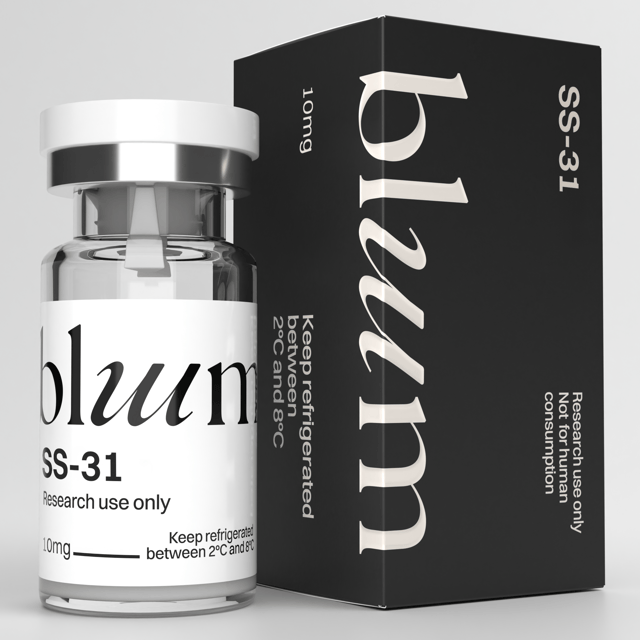
SS-31







Lab results
RESEARCH USE ONLY
These compounds are NOT intended for human consumption, clinical use, or veterinary applications. We are not affiliated with any pharmaceutical companies or their commercial medications. By placing an order, you certify these materials will be used exclusively for in vitro testing and laboratory experimentation only. Bodily introduction of any kind into humans or animals is strictly forbidden by law. This product should only be handled by licensed, qualified professionals. This product is not a drug, food, or cosmetic and may not be misbranded, misused or mislabeled as a drug, food or cosmetic.
About SS-31
SS-31, also known as elamipretide or MTP-131, is a synthetic tetrapeptide used in laboratory studies of mitochondrial membranes. Its sequence contains D-arginine, 2,6-dimethyl-L-tyrosine, L-lysine, and a C-terminal L-phenylalaninamide. This aromatic-cationic structure distinguishes SS-31 from longer mitochondrial-derived peptides.
Published biochemical studies have examined SS-31 binding to cardiolipin, a phospholipid of the inner mitochondrial membrane. In experimental cardiolipin–cytochrome c systems, researchers have investigated changes in cytochrome c peroxidase activity, electron transport, and membrane-associated bioenergetics. SS-31 provides a defined peptide for studying these interactions in controlled laboratory models; published findings do not establish the performance of an individual Bluum lot.
Bluum supplies SS-31 in 10 mg and 50 mg lyophilized vials. The current Freedom Diagnostics reports confirm SS-31 identity by LC-MS and report HPLC-UV purity of 99.88% for 10 mg lot 2S102609-137K and 99.79% for 50 mg lot 2S502609-137K. Each lot also has reported endotoxin, microbial PCR, and elemental-impurity results. Select the vial size to view its current lot and corresponding laboratory documents; labeled vial content and measured net content are listed separately in the COA.
For research use only. Not for human or animal consumption. Not for diagnostic or therapeutic use.
SS-31 Product Specifications
| Product Specifications | 10 mg or 50 mg lyophilized peptide per vial |
|---|---|
| Application | Controlled laboratory research on cardiolipin and mitochondrial membrane interactions |
| Peptide Classification | Synthetic tetrapeptide; white lyophilized powder per current lot COAs |
| Purity | 99.88% (10 mg, lot 2S102609-137K); 99.79% (50 mg, lot 2S502609-137K), HPLC-UV |
| Chemical Formula | C32H49N9O5 (parent peptide, excluding counterions) |
| PubChem CID | 11764719 (parent peptide) |
| CAS Number | 736992-21-5 (parent peptide) |
| Molecular Weight | 639.8 g/mol (parent peptide, excluding counterions) |
| Synonyms | SS-31; elamipretide; MTP-131 |
| Peptide Sequence | H-D-Arg-2,6-dimethyl-L-Tyr-L-Lys-L-Phe-NH₂ |
| Storage | Keep refrigerated between 2°C and 8°C, per supplied labels |
SS-31 Mechanism of Action
SS-31 (elamipretide, MTP-131) is a synthetic, cell-permeable tetrapeptide with the sequence D-Arg-Dmt-Lys-Phe-NH2, where Dmt is 2′,6′-dimethyl-L-tyrosine. It belongs to the Szeto-Schiller (SS) peptides, a class of aromatic-cationic peptides that concentrate in the inner mitochondrial membrane. Published studies link this targeting to interactions with cardiolipin, an anionic phospholipid of the inner membrane. [1][2][3]
Aromatic-Cationic Structure
SS-31's four residues alternate between basic and aromatic side chains: D-arginine, 2′,6′-dimethyl-L-tyrosine, L-lysine, and C-terminally amidated L-phenylalanine. Its WHO-assigned chemical name is D-arginyl-2,6-dimethyl-L-tyrosyl-L-lysyl-L-phenylalaninamide (C32H49N9O5, CAS 736992-21-5). [1] This alternating aromatic and basic motif is the defining structural feature of the SS peptide class. [2]
SS-31 contains the same four residues as its parent peptide, SS-02 (H-Dmt-D-Arg-Phe-Lys-NH2), arranged in a different order. Both are small (molecular weight about 640), highly polar peptides that carry a net charge of +3 at physiological pH. [3]
Discovery and Cellular Uptake
SS peptides emerged from work on an earlier synthetic tetrapeptide, SS-02, also known as [Dmt1]DALDA. Despite its polarity and charge, SS-02 was taken up by a variety of cell types without specific transporters or receptors, and a fluorescent analogue revealed highly selective mitochondrial targeting. SS-31 and SS-20 were then designed as analogues that keep this inner-membrane targeting. [3]
In isolated mitochondria, SS-02 was rapidly taken up and partitioned to the inner mitochondrial membrane, with minimal presence in the matrix. Unlike lipophilic cations such as mitoquinone (MitoQ), its uptake did not rely on mitochondrial membrane potential and did not depolarize the mitochondria. [3] SS peptides have been reported to concentrate more than 1,000-fold in the inner mitochondrial membrane. [2]
Cardiolipin Binding
Cardiolipin is a dianionic phospholipid of the inner mitochondrial membrane that promotes membrane curvature, supports cristae formation, and helps respiratory complexes assemble into supercomplexes. [3] In liposome and bicelle studies, SS-31 interacted only with membranes containing cardiolipin (not with phosphatidylcholine alone), at roughly a 1:1 ratio, and NMR data showed its aromatic residues penetrating deep into cardiolipin-containing bilayers. [4] The proposed binding model pairs electrostatic interaction between the arginine and lysine side chains and the cardiolipin phosphate head groups with insertion of the Dmt and phenylalanine rings into the acyl chain region. [3]
Later biophysical work refined this picture. SS-31 partitions into the membrane interfacial region with an affinity and binding density tied to membrane surface charge. Reported dissociation constants (per lipid) were about 2.0–2.9 μM for membranes containing 20% cardiolipin or monolysocardiolipin, compared with 6.0–13 μM for membranes containing 20% phosphatidylglycerol. SS-31 binding did not destabilize lamellar bilayers, even at the highest binding concentrations, but caused saturable changes in lipid packing. [5]
Cytochrome c and Electron Transport
Cytochrome c carries electrons from complex III to complex IV while loosely held at the membrane by electrostatic attraction to cardiolipin. About 10–15% of cytochrome c can instead bind cardiolipin tightly through hydrophobic interactions. This disrupts the Met80–heme iron coordination and converts cytochrome c from an electron carrier into a peroxidase that oxidizes cardiolipin. [3] Elamipretide's WHO name listing describes it as a cardiolipin peroxidase inhibitor. [1]
In vitro, SS-31 inhibited the peroxidase activity of the cytochrome c/cardiolipin complex while preserving cytochrome c's electron-carrier function. It restored cytochrome c reduction and mitochondrial oxygen consumption in the presence of added cardiolipin, and in freshly isolated mitochondria it increased state 3 respiration and the efficiency of ATP synthesis. [4]
Membrane Surface Electrostatics
SS-31 reduced the surface potential of both model and mitochondrial membranes, and the related peptide SS-20 had the same effect, suggesting a general feature of SS peptides. SS-31 also altered the distribution of calcium ions within the membrane interfacial region. [5] All-atom molecular dynamics simulations of mitochondria-targeted tetrapeptides reproduce this electrostatic modulation: the peptides lowered the membrane dipole potential by disordering lipid head groups and nearby water layers, displaced cations from the bilayer surface, reduced bilayer thickness, and increased membrane capacitance. [6]
Mitochondrial Protein Interactions
Chemical cross-linking with mass spectrometry, using an N-terminally biotinylated SS-31 in isolated mouse cardiac mitochondria, identified 12 interacting proteins. All are known cardiolipin-binding proteins, and they fall into two groups: oxidative phosphorylation and ATP-production proteins, including ATP synthase α and β subunits, ADP/ATP translocase, and complex III subunits, and proteins involved in 2-oxoglutarate metabolism, including 2-oxoglutarate dehydrogenase complex subunits. Many of the cross-linked sites lie near known cardiolipin–protein interaction regions. [7]
Radical Scavenging and the Role of Dmt
Early studies reported that SS peptides scavenge hydrogen peroxide and peroxynitrite and inhibit lipid peroxidation, activity attributed to their tyrosine or dimethyltyrosine residue. [2] However, SS-20 (Phe-D-Arg-Phe-Lys-NH2), which lacks Dmt and does not scavenge free radicals, also targets mitochondria, and later structure–activity work concluded that radical scavenging is not an essential feature of this compound class's mechanism. [8]
Overall, SS-31 provides a defined research model for studying cardiolipin binding, cytochrome c function, membrane surface electrostatics, and inner mitochondrial membrane protein interactions. The specific response depends on membrane lipid composition, mitochondrial source and preparation, cell type, assay format, and experimental conditions.
SS-31 Research Applications
SS-31's characterized membrane and cardiolipin interactions make it useful across several areas of mitochondrial biochemistry, membrane biophysics, and peptide chemistry research. Experimental applications include:
Cardiolipin–Protein Interaction Research
SS-31 can serve as a defined cardiolipin-binding ligand for studies of how cardiolipin organizes inner membrane proteins. Its published cross-linking interactome provides a reference set of candidate interaction partners, and N-terminally biotinylated SS-31 has been used as an affinity handle for enriching cross-linked complexes. [7]
Cytochrome c Peroxidase and Electron Transfer Assays
Because SS-31 separates the peroxidase and electron-carrier functions of the cytochrome c/cardiolipin complex in vitro, it is used in liposome, mitoplast, and isolated mitochondria assays that measure cytochrome c reduction, peroxidase activity, and oxygen consumption. [3][4]
Membrane Biophysics and Electrostatics
SS-31 is a well-characterized probe for studying how cationic peptides interact with anionic membranes. Published approaches include binding isotherms with cardiolipin- and phosphatidylglycerol-containing vesicles, calorimetry, zeta potential and ANS fluorescence measurements of surface potential, and analysis of lipid packing. Comparing membranes with different anionic lipids helps separate charge-driven effects from cardiolipin-specific ones. [5]
Isolated Mitochondria and Bioenergetics Research
In isolated mitochondria and mitoplasts, SS-31 has been studied for its effects on oxygen consumption, state 3 respiration, ATP synthesis efficiency, membrane surface potential, and calcium distribution at the membrane interface. Results depend on mitochondrial source, preparation method, substrates, and assay conditions, so these variables should be matched when comparing studies. [4][5]
Peptide Structure–Activity Research
SS-31 serves as the benchmark in structure–activity studies of aromatic-cationic tetrapeptides. One study compared it with three analogues that differ in aromatic side chains and sequence register: SPN4 (Dmt replaced by tyrosine), SS-20, and the tryptophan-containing SPN10 (Trp-Arg-Trp-Lys-NH2). NMR and molecular dynamics models showed that all of the analogues except SS-31 adopted compact reverse-turn conformations when membrane-bound. All four bound cardiolipin-containing membranes with similar affinity but differed in binding stoichiometry and in their effects on membrane surface charge. [8]
The same study found no strict requirement for side chain composition or sequence register for cell permeation and mitochondrial targeting in cultured mammalian cells. The analogues did differ in their effects on mitochondrial membrane potential, ATP content, and cell viability in serum-withdrawal cell stress models. [8]
Computational and Molecular Dynamics Research
SS-31 and its analogues are used in all-atom molecular dynamics simulations of peptide–membrane interactions. These models examine membrane dipole and surface potentials, bilayer thickness, capacitance, and cation distribution, and they can be compared directly with experimental electrostatics measurements. [6][8]
Overall, SS-31 provides a defined research model for investigating cardiolipin biology, cytochrome c function, membrane electrostatics, mitochondrial bioenergetics, and peptide design in controlled experimental systems.
SS-31 vs MOTS-c vs NAD+ Comparison
SS-31 can be compared with other mitochondria-related research compounds to examine how structure, origin, and site of action shape experimental outcomes. MOTS-c is a mitochondria-derived peptide studied in metabolic signaling research. NAD+ is a coenzyme rather than a peptide, central to cellular redox reactions and NAD+-dependent enzymes.
Comparison | SS-31 | ||
Compound class | Synthetic aromatic-cationic tetrapeptide | Mitochondria-derived peptide | Dinucleotide coenzyme (not a peptide) |
Origin | Synthetic; Szeto-Schiller peptide series | Encoded by a short open reading frame in mitochondrial DNA | Naturally occurring in all living cells |
Size | 4 residues; about 640 Da | 16 residues; about 2.2 kDa | About 663 Da |
Primary research target | Cardiolipin in the inner mitochondrial membrane | AMPK-associated metabolic and stress-response signaling | Redox reactions and NAD+-dependent enzymes such as sirtuins and PARPs |
Main site of study | Inner mitochondrial membrane | Cytoplasm, with reported nuclear translocation under metabolic stress | Separate cytosolic, mitochondrial, and nuclear pools |
Mechanism focus | Membrane binding, cytochrome c/cardiolipin interactions, and surface electrostatics | Signaling and gene-expression responses | Electron carrier (NAD+/NADH) and enzyme substrate |
Typical readouts | Lipid binding, cytochrome c peroxidase activity, oxygen consumption, membrane surface potential | AMPK pathway activity and metabolic gene expression | NAD+/NADH ratio and NAD+-dependent enzyme activity |
Primary research focus | Cardiolipin biology and inner membrane biophysics | Mitochondrial-to-nuclear signaling and cellular energy regulation | Cellular bioenergetics and redox metabolism |
Note: All materials listed for laboratory research use only
Although all three compounds are studied in mitochondrial research, they should not be treated as interchangeable research tools. SS-31 is centered on cardiolipin and inner membrane interactions, MOTS-c on mitochondria-derived signaling, and NAD+ on redox chemistry and NAD+-dependent enzymes.
These differences make the compounds useful for comparative studies that separate membrane-level effects from signaling and metabolic cofactor effects.
Other Related Peptides and Reference Compounds
SS-02 ([Dmt1]DALDA) is the parent peptide of the series. It shares SS-31's four residues in a different order and was the peptide used in the original cellular and mitochondrial uptake studies. [3]
SS-20 (Phe-D-Arg-Phe-Lys-NH2) also targets the inner mitochondrial membrane but lacks Dmt and does not scavenge free radicals. It modulates membrane surface potential much like SS-31, which makes it a useful comparator for separating radical scavenging from membrane effects. [3][5][8]
SPN4 and SPN10 are newer tetrapeptide analogues that vary the aromatic residues and sequence register, and they provide structure–activity context for SS-31. [8]
Mitoquinone (MitoQ), a lipophilic cation, is a useful contrast: its mitochondrial accumulation is driven by membrane potential, whereas uptake of the parent peptide SS-02 did not depend on it. [3]
These compounds can be useful comparative tools, but findings from one peptide, membrane system, or species should not automatically be extrapolated to another. Experimental results depend on factors including lipid composition, mitochondrial preparation, peptide structure, cell type, and assay conditions.
Storage & Laboratory Handling
SS-31 is supplied as a lyophilized research peptide. Proper storage and laboratory handling can help maintain sample integrity and preserve the material's analytical characteristics.
Keep the vial tightly sealed when not being handled.
Store at the temperature listed on the product label and in the lot-specific documentation.
Protect the material from excessive heat, light, and moisture.
Minimize exposure to ambient humidity during handling.
Avoid unnecessary temperature fluctuations and repeated freeze-thaw cycles.
When transferring a refrigerated or frozen vial between environments, keep the container sealed while it equilibrates to help minimize condensation.
Use clean laboratory handling practices appropriate for peptide research materials.
Maintain the original product label and batch/lot information for traceability.
Retain the applicable Certificate of Analysis (COA) with the batch documentation.
Follow laboratory-specific standard operating procedures and applicable institutional requirements.
Peptide stability can vary with formulation, storage conditions, handling, and the specific production batch. Researchers should therefore avoid assuming a universal shelf life or stability profile and should refer to the current storage guidance, product documentation, and validated laboratory procedures for the specific SS-31 material being studied.
Third-Party Testing & COA
When you buy SS-31 from Bluum Peptides, you can review batch-specific analytical documentation for the research material you receive. Each new batch is independently tested by third-party laboratories for applicable parameters including identity, purity, net content, and endotoxin, with the results documented in a Certificate of Analysis (COA). Depending on the lot, testing can also include microbial PCR (sterility) and elemental impurities.
You can also use the Bluum Peptides COA Lookup page to access available certificates and review the analytical results for individual production lots. The documentation also identifies the independent laboratory responsible for the testing, providing additional traceability for the reported results.
Because analytical results can vary between production lots and vial sizes, refer to the current batch-specific COA for the exact identity, purity, net content, endotoxin results, and other applicable quality-control data for the material you receive.
Frequently Asked Questions About SS-31
What is SS-31?
SS-31, also known as elamipretide or MTP-131, is a synthetic tetrapeptide (D-Arg-Dmt-Lys-Phe-NH2) from the Szeto-Schiller peptide series. It is an aromatic-cationic peptide that concentrates in the inner mitochondrial membrane and is studied for its interactions with the phospholipid cardiolipin.
What is SS-31 used for in research?
SS-31 is used as a research material for investigating cardiolipin binding, cytochrome c peroxidase and electron-transfer activity, membrane surface electrostatics, and bioenergetics in isolated mitochondria. It is also used in protein interaction mapping, structure–activity studies of aromatic-cationic peptides, and molecular dynamics simulations of peptide–membrane interactions.
How does SS-31 interact with cardiolipin?
SS-31's arginine and lysine side chains are proposed to interact electrostatically with the phosphate head groups of cardiolipin, while its aromatic rings insert into the acyl chain region of the bilayer. Its membrane affinity tracks surface charge: binding was stronger for membranes containing cardiolipin or monolysocardiolipin than for membranes containing phosphatidylglycerol.
How is SS-31 different from lipophilic mitochondria-targeted compounds such as mitoquinone?
Lipophilic cations such as mitoquinone (MitoQ) accumulate in mitochondria in response to the membrane potential. SS peptides instead partition to the inner mitochondrial membrane, and uptake of the parent peptide SS-02 did not rely on membrane potential or cause depolarization. SS-31 is also a hydrophilic peptide rather than a lipophilic small molecule.
How is SS-31 different from MOTS-c?
SS-31 is a synthetic four-residue peptide that binds the inner mitochondrial membrane and is studied mainly through cardiolipin and membrane interactions. MOTS-c is a 16-residue peptide encoded in mitochondrial DNA and is studied mainly in metabolic and stress-response signaling research. The two are used to answer different experimental questions.
How is SS-31 tested for purity and identity?
SS-31 can be characterized using high-performance liquid chromatography (HPLC) and mass spectrometry, such as LC-MS. HPLC provides information about chromatographic purity, while mass spectrometry helps confirm molecular identity and mass characteristics. If you buy SS-31 from Bluum Peptides, you can review the batch-specific Certificate of Analysis (COA) for the analytical results associated with the material you receive.
Where can I buy SS-31 for laboratory research?
You can buy SS-31 from Bluum Peptides as a lyophilized research peptide in 10 mg and 50 mg vials. Each lot is independently tested, and the batch-specific Certificate of Analysis lists the exact identity, purity, net content, and endotoxin results for that lot and size. SS-31 is sold strictly for laboratory research use and is not intended for human or veterinary use.
Scientific References
World Health Organization. International Nonproprietary Names for Pharmaceutical Substances (INN): Proposed INN List 113. WHO Drug Information. 2015;29(2):216.
Szeto HH. Cell-permeable, mitochondrial-targeted, peptide antioxidants. AAPS J. 2006 Apr 21;8(2):E277-E283.
doi: 10.1007/BF02854898. PMID: 16796378; PMCID: PMC3231562.Szeto HH, Birk AV. Serendipity and the discovery of novel compounds that restore mitochondrial plasticity. Clin Pharmacol Ther. 2014 Dec;96(6):672-683.
doi: 10.1038/clpt.2014.174. Epub 2014 Sep 4. PMID: 25188726; PMCID: PMC4267688.Birk AV, Chao WM, Bracken C, Warren JD, Szeto HH. Targeting mitochondrial cardiolipin and the cytochrome c/cardiolipin complex to promote electron transport and optimize mitochondrial ATP synthesis. Br J Pharmacol. 2014 Apr;171(8):2017-2028.
doi: 10.1111/bph.12468. PMID: 24134698; PMCID: PMC3976619.Mitchell W, Ng EA, Tamucci JD, Boyd KJ, Sathappa M, Coscia A, Pan M, Han X, Eddy NA, May ER, Szeto HH, Alder NN. The mitochondria-targeted peptide SS-31 binds lipid bilayers and modulates surface electrostatics as a key component of its mechanism of action. J Biol Chem. 2020 May 22;295(21):7452-7469.
doi: 10.1074/jbc.RA119.012094. Epub 2020 Apr 9. PMID: 32273339; PMCID: PMC7247319.Tamucci JD, Alder NN, May ER. Peptide Power: Mechanistic Insights into the Effect of Mitochondria-Targeted Tetrapeptides on Membrane Electrostatics from Molecular Simulations. Mol Pharm. 2023 Dec 4;20(12):6114-6129.
doi: 10.1021/acs.molpharmaceut.3c00480. Epub 2023 Oct 30. PMID: 37904323; PMCID: PMC10841697.Chavez JD, Tang X, Campbell MD, Reyes G, Kramer PA, Stuppard R, Keller A, Zhang H, Rabinovitch PS, Marcinek DJ, Bruce JE. Mitochondrial protein interaction landscape of SS-31. Proc Natl Acad Sci U S A. 2020 Jun 30;117(26):15363-15373.
doi: 10.1073/pnas.2002250117. Epub 2020 Jun 17. PMID: 32554501; PMCID: PMC7334473.Mitchell W, Tamucci JD, Ng EL, Liu S, Birk AV, Szeto HH, May ER, Alexandrescu AT, Alder NN. Structure-activity relationships of mitochondria-targeted tetrapeptide pharmacological compounds. eLife. 2022 Aug 1;11:e75531.
doi: 10.7554/eLife.75531. PMID: 35913044; PMCID: PMC9342957.
Related Peptides

Reconstitution Solution
$15.00
BPC-157
From $39.00
GHK-Cu
From $45.00
Tesamorelin
From $69.00
KLOW Peptide Blend (GHK-Cu / BPC-157 / TB-500 / KPV)
$119.00
MOTS-c
From $39.00
NAD+
From $57.00
BPC-157 / TB-500
From $90.00
PT-141
$35.00
GLOW (BPC-157/TB-500/GHK-Cu)
$115.00
CJC-1295 No DAC / Ipamorelin Blend
$75.00
TB-500
From $35.00


You ask,
we answer.
Are these peptides quality tested?
Yes. Every lot is tested by an independent third-party lab before it ships, mostly Freedom Diagnostics or Horizon Analytical, and some by BioRegen. Peptide lots are tested for purity (HPLC) and identity (mass spectrometry), and most lots also for net content and endotoxin. Purity varies from lot to lot, so we publish each lot's measured result rather than a fixed guarantee. The report for the lot on sale, with the lab, test date and results, is shown in the lab results on this page and in our lab report library.
What are typical delivery times?
One-time U.S. orders ship free by 2-Day Air when merchandise totals $200 or more after discounts; below $200, 2-Day Air is $11.99. Overnight Air is $34.99. In-stock orders placed before 1 p.m. CT on a business day ship the same day; later orders ship the next business day. Subscriptions only: 2-Day Air is free once the subscribed items reach $50, on the first order and on every renewal.
Every package comes with professional packaging and tracking updates via email.
How should these compounds be stored?
Our peptides are shipped in lyophilized form, which is stable at room temperature during transit. Once received, store unopened vials in a cool, dry place.
Are products stable during shipping?
Our peptides ship sealed and lyophilized (freeze-dried), not on ice. Sealed lyophilized peptides generally show minimal degradation from brief room-temperature exposure in standard transit, though stability varies by compound, moisture, seal integrity and light. Each lot's purity result is published in our lab report library.
What are your bulk ordering options?
For bulk inquiries and volume pricing, please contact us.
What is the shelf life/expiration of unopened vials?
Each lot lists a best-by/expiration on the vial label and COA. As general guidance, lyophilized peptides stored as directed are typically stable 12–24 months (often longer at –20 °C). Short shipping periods at ambient temperature are normal. Actual stability depends on sequence and storage conditions.
